Fairfield DCP 2013 — The Parts Council Actually Makes You Fix
I've lodged more plans into Fairfield City Council than I can count. Our office is two streets over from the chambers, and most of our work sits inside the LGA. What I've learned is that there's a difference between what a DCP says on paper and what a council actually stops you doing. Fairfield DCP 2013 is over 400 pages. Ninety per cent of it gets waved through. Ten per cent is where every RFI, every re-lodgement, and every extra four weeks of timeline comes from.
This is the ten per cent. If you're lodging something residential in Fairfield — a duplex on an R3 block, a knockdown rebuild, a new custom home, a secondary dwelling — these are the parts of the DCP that will actually be enforced against you. Get these right the first time and you'll approve in 10–14 business days. Get one of them wrong and you'll wait another month.
Deep Soil and Landscaped Area — The Single Most Common Rejection
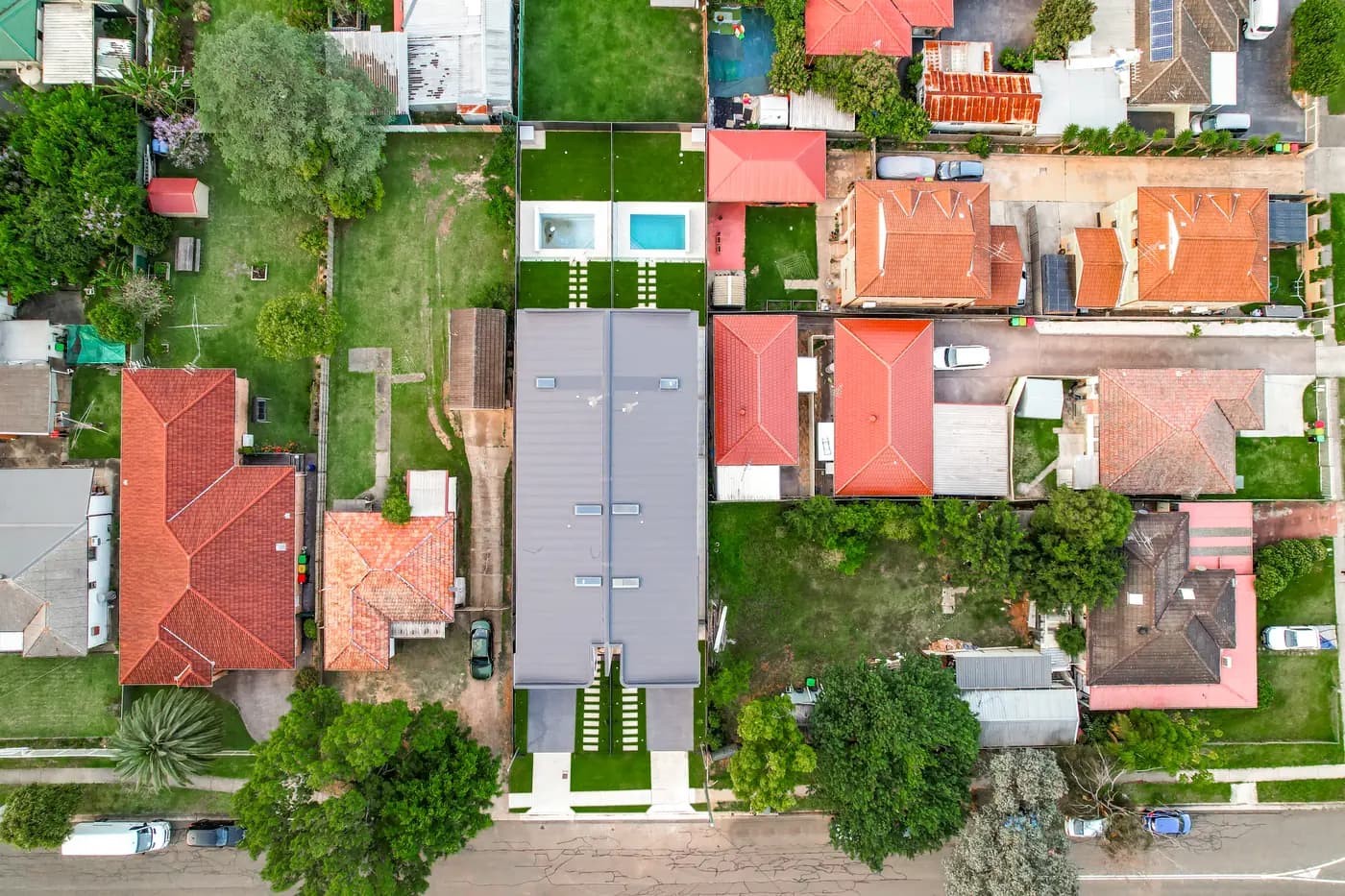
Fairfield DCP Part B, Section 2 — landscaped area. This is where more plans get bounced than anywhere else in the document. The numbers aren't complicated: 45% minimum landscaped area on R2 residential, 25% minimum deep soil (ground-connected soil, not planter boxes over a slab). For R3 dual occupancy the deep soil jumps to 30% because two dwellings put more pressure on drainage and microclimate.
Where people get caught: driveway paving, concrete alfresco pads, and tiled pool surrounds all count AGAINST landscaped area. A plan that looks like it has plenty of garden on paper frequently fails the actual calc once you subtract every hard surface. Council's planners do this calc line-by-line. If you're on a 556sqm R3 block and your driveway + dwellings + alfresco + pool coping adds up past 417sqm (75% of the site), you will get sent back.
The fix is design-stage, not submission-stage. Draw your landscaped area as a distinct hatched zone on the site plan and tot it up before you lodge. Council wants to see the number stated explicitly, not inferred from the plan.
Setbacks — The DCP Numbers and the Unwritten Rule
Front setback on R2: 6m typical, varies by street character. Side setback: 900mm minimum both sides. Rear setback: 3m for single storey, 6m for two storey at upper level.
The unwritten rule is street-character matching. If every neighbouring house on your street sits at 8m from the kerb, drawing yours at 6m will trigger an objection from a neighbour and a reassessment from council — even though 6m is technically compliant. I have seen this cost clients 6 weeks. Look at the three houses either side before you draw your front line.
On a duplex under CDC the side setback math gets tighter. CDC's default rule is 0.9m for blocks up to 18m wide — but Fairfield's DCP adds 1.5m for the upper floor on a two-storey build, and CDC defers to the DCP for anything DCP has specifically spoken to. Half the duplex plans I see from other designers miss this and end up with a first-floor wall sitting 900mm off the neighbour's boundary. Council will make you redraw it.
Parking and the Crossover — A Rule Most People Miss
DCP Part B, Section 4 — parking. The headline number is two spaces for a single dwelling, two per dwelling for a duplex. That part is easy.
The part that catches people is the crossover geometry. Fairfield enforces a maximum combined crossover width of 6m on R2 lots with frontage under 18m. If you're drawing a 3-garage house on a 15m-wide Fairfield lot, you will fail this test. The fix is either a tandem garage (one behind the other) or reducing to a double.
Also watch the crossover offset from the side boundary. 1m minimum. And from the nearest street tree — 2m minimum, and council arborists do check this. If there's a street tree near your proposed crossover you may need to relocate the driveway, which can ripple into the front setback of the house.
Stuck on approvals?
We've taken hundreds of projects through CDC and DA. Tell us your address and approval pathway — we'll map the realistic timeline.
FSR and Building Height — Where the DCP Is Actually Firm
Floor Space Ratio on R2 in most Fairfield suburbs: 0.5:1 (so a 600sqm lot gets a 300sqm gross floor area maximum). On R3 it's typically 0.6:1 but can vary by precinct — check the LEP map, don't assume.
Fairfield counts GFA the way the LEP says it should be counted, which means: • Basement garages: excluded • Attached garages: included • Alfresco under main roof: included if enclosed on 3 sides • Stair voids: counted once (at ground level) • Porch under 5sqm: excluded
Building height: 8.5m on R2 single dwelling, 9m on R3 duplex. This is measured to the ridge, not the eaves, and from existing ground level before any filling or cutting. I have seen builders cut the site 400mm to gain extra height — council picks this up by comparing your RL figures against the contour survey. Don't try it.
Solar Access — The Rule That Catches Two-Storey Builds
DCP Part B, Section 3 — solar access. The rule: 3 hours of direct sunlight between 9am and 3pm on June 21 to the principal living area AND private open space of adjoining dwellings.
If your proposed two-storey home or duplex casts a shadow across a southern neighbour's backyard or living-room window, you will get an objection in notification and council will request a shadow diagram that demonstrates compliance. If it doesn't comply, you'll need to reduce the upper floor envelope.
The way to head this off at design stage is to commission a shadow diagram BEFORE lodgement, not after the RFI. It costs $400–$600 and saves 4–6 weeks if it flags a problem you can fix on paper.
Secondary Dwellings — Fairfield's 60sqm Interpretation
State Environmental Planning Policy (Housing) 2021 allows a 60sqm secondary dwelling under CDC. Fairfield enforces this cap strictly — not 62sqm, not 61sqm, 60sqm. And they measure internal (gross floor area), not external.
The bits that don't count toward 60sqm: • Covered alfresco (if open on two sides) • Verandah • Carport attached to the granny flat
The bits that DO count even though people assume they don't: • Laundry if internal • Storage/cupboard rooms • Bay window nooks
Fairfield also enforces a 450sqm minimum lot size for a secondary dwelling, which is below the statewide CDC number — so blocks some other councils would reject clear here. But the 12m minimum lot width rule still applies.
Fixed-price estimate
Get a real number for your block
Two minutes now saves the guesswork. Oliver or one of the team calls back with a realistic range for your suburb and block, then books a free site walk if you want a fixed price.
- Priced off your block, not a brochure — soil, slope and council read first
- NSW licensed builder 487805C. HBCF insured. Fixed-price HIA contract.
- Reply within 4 working hours. No sales pressure, ever.
The RFI Pattern — What Council Actually Asks For
After 40+ lodgements through Fairfield in the last three years, the RFI pattern is consistent. In rough order of frequency:
1. Landscaped area / deep soil calculation missing or wrong — 35% of RFIs 2. Shadow diagram requested for two-storey work — 20% 3. Stormwater concept plan non-compliant (on-site detention calc) — 15% 4. Crossover geometry or setback issue — 12% 5. BASIX certificate expired or mismatched to plans — 10% 6. Waste management plan missing — 8%
Every one of these is preventable at design stage. Get your landscape architect (or draftsperson if it's a simple job) to produce a hatched landscaped-area plan with the numeric sum. Get a shadow diagram for anything two-storey. Get a stormwater engineer's concept plan with OSD tank sizing before you lodge. Don't rely on the certifier to catch these — by the time they do, you've already lost two weeks.
What Gets Approved Fast vs What Doesn't
Fairfield's median CDC turnaround is 10–14 business days. DA turnaround for a straightforward residential application is 40–55 days. Where things slow down:
Fast track (CDC, 10–14 days): • New single dwelling on a vacant R2 block • Secondary dwelling on a 450sqm+ R2 block with 12m+ width • Single-storey extension under 50sqm • Attached duplex on R3 with all DCP landscaped-area and setback boxes ticked
Slow track (DA, 40+ days): • Anything heritage-adjacent (Fairfield CBD conservation zone, Old Fairfield, sections of Canley Vale) • Dual occupancy on R2 under the 2024 reform — still DA in most Fairfield precincts, CDC in some • Any variation to DCP controls (even 5%) • Sites with contamination history (check the 149 certificate) • Sites in flood precincts (parts of Lansvale, Carramar, Villawood)
If you're in the fast track, Buildana gets CDC approval for Fairfield projects in under three weeks. If you're in the slow track, plan for 10–14 weeks end-to-end and use the wait productively to finalise your finishes and engage your colour consultant.
To check which track your specific site sits in, or to run your plans past us before lodgement, get in touch via /contact or call 0476 300 300.