The Liverpool OSD Surprise — Why Good Numbers Stop Stacking
On-site detention. Three letters that quietly kill more Liverpool feasibilities than almost anything else. First-time developers do the land maths, add construction cost, run the rental numbers, and build a spreadsheet that looks great. Then they get the engineer's stormwater report back and find out they need a 15,000-litre underground detention tank on a reactive-clay site — and $38,000 to $55,000 disappears from their margin they didn't know was leaving.
I've watched this happen to clients more than once. The fix isn't engineering-heroics at submission time. The fix is knowing the rules before you buy the land. What follows is what Liverpool City Council actually enforces for stormwater on residential developments — duplexes, KDRs, granny flats — and the specific cost and design implications for your project.
What Triggers OSD in Liverpool LGA
Liverpool Council's DCP (Part 1.4 — Stormwater Management) sets OSD thresholds by property type and impervious-area increase. Simplified:
• Any new development that increases impervious area by more than 50sqm over existing: OSD required • All new duplexes: OSD required regardless of existing impervious • All new secondary dwellings on a lot with existing impervious over 50% of site area: OSD required • Knockdown rebuild where the new impervious exceeds the old by 50sqm+: OSD required
In practice, almost every residential development in Liverpool needs OSD. The question isn't 'do I need it' but 'how big does it have to be'. That number depends on your site area, the new roof and paved area, the soil type for infiltration, and whether Council classifies your downstream system as overloaded (it often is in older parts of the LGA).
Sizing the Tank — The Spreadsheet Council Uses
Your hydraulic engineer runs DRAINS or PCDrain software against Liverpool's rainfall IFD data. The output is site storage volume and a peak discharge rate.
Typical results for Liverpool residential projects:
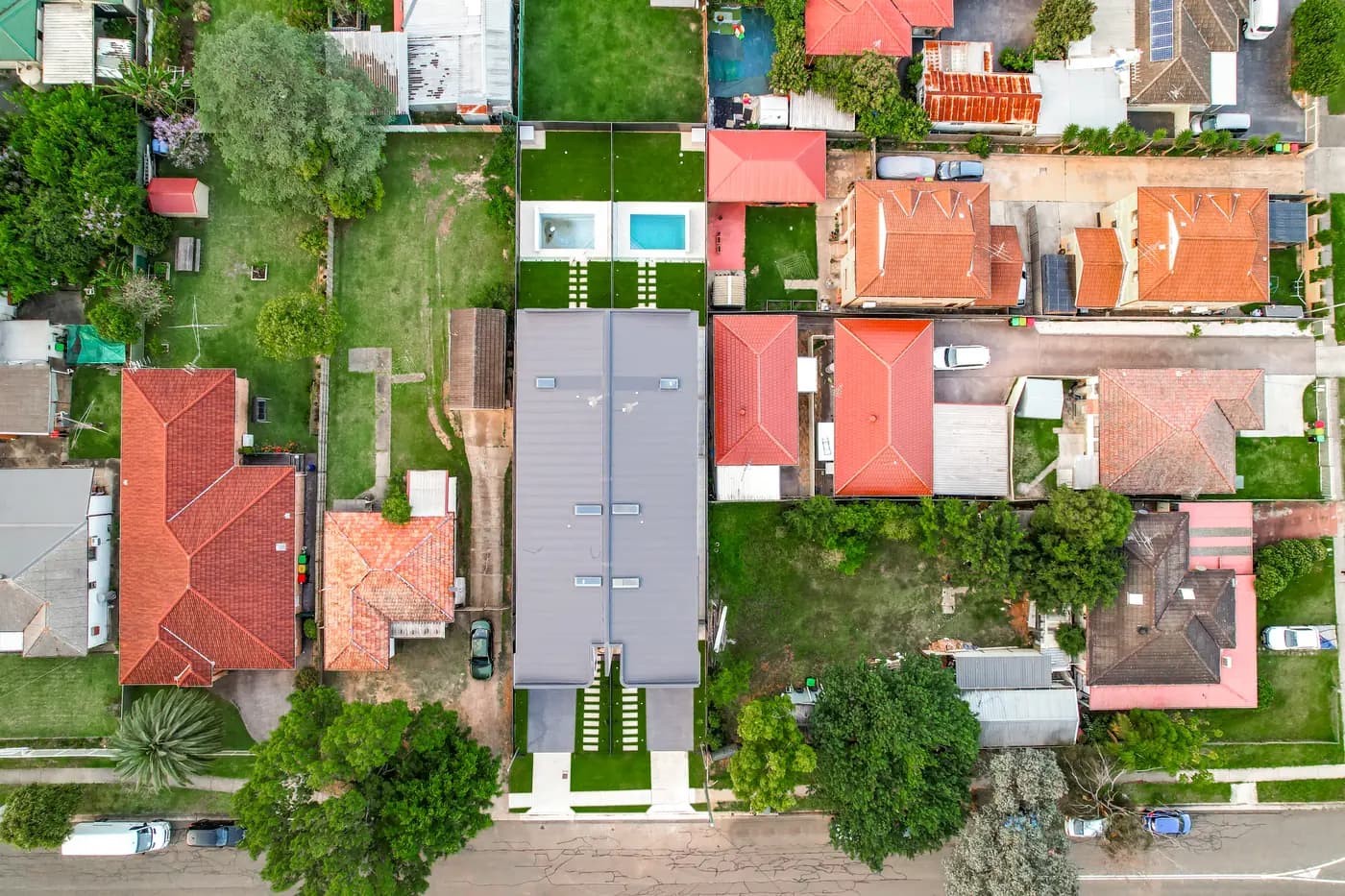
• 60sqm secondary dwelling behind an existing home, 650sqm lot: 4–7kL tank • New single dwelling KDR on 650sqm, 280sqm home footprint: 8–12kL tank • Attached duplex on 600sqm R3, two 165sqm homes: 14–20kL tank • Detached duplex on 720sqm, two 180sqm homes: 16–22kL tank
These are typical, not universal. A site in Casula with high infiltration can go smaller. A site in Warwick Farm with a known downstream bottleneck can jump 30%. The only reliable number is the one your engineer calculates for your specific site.
Stuck on approvals?
We've taken hundreds of projects through CDC and DA. Tell us your address and approval pathway — we'll map the realistic timeline.
The Cost — What You're Actually Paying For
Breaking down a 15kL OSD tank cost in Liverpool (Buildana 2026 actuals):
• Tank supply (concrete pre-cast or fibreglass): $6,500–$11,000 • Excavation and crane placement: $7,500–$12,000 (higher if rock or reactive clay) • Orifice plate and PVC outlet works: $1,200–$2,000 • Inspection opening, surface lid, surrounds: $1,800–$2,800 • Pipework between dwellings and tank: $3,000–$6,000 • Engineering design and certification: $3,500–$5,500 • Council audit fee: $500–$900
Total installed cost for a 15kL OSD system: $24,000–$40,000
For a 20kL tank on a duplex: $32,000–$55,000. For a smaller 5kL tank on a granny flat: $12,000–$18,000.
First-time developers who didn't bake this into feasibility discover it when the engineer's report lands on their desk three weeks before lodgement. At that point the land contract is usually unconditional and there's nowhere for the cost to go except their margin.
The Reactive-Clay Problem in Liverpool
Large chunks of Liverpool LGA sit on Class H reactive clay — Moorebank, Chipping Norton, Prestons, Hoxton Park all have significant Class H or H2 zones. Reactive clay matters for OSD because:
1. Infiltration is near zero. You can't rely on the tank slowly seeping into soil; it must discharge through an orifice at a controlled rate. This means the tank size is driven by detention volume, not a smaller detention+infiltration combo.
2. Tank excavation is harder. Reactive clay is strong when wet, rock-like when dry, and moves seasonally. Excavators need larger machinery, tanks need deeper edge beams, and backfill specs tighten to prevent tank settlement pulling pipework apart.
3. Structural slab interaction. The tank pit creates a localised soil moisture condition that can affect the house slab if it's close. Engineering needs to coordinate so the slab edge isn't destabilised.
If you're buying in one of these suburbs, get a preliminary geotech report BEFORE the cooling-off period ends. $1,200 saves you from discovering a Class H clay issue after the land is yours.
What About CDC — Does It Skip the OSD Requirement?
No. CDC doesn't override local stormwater policy. The CDC pathway accepts council's OSD requirements as part of the certifier's check. If the local DCP says you need a 12kL tank, your CDC certifier will enforce exactly that before issuing the certificate.
What CDC does do is speed up the administrative layer — you're not lodging with council and waiting 40+ days, you're lodging with a private certifier and getting a decision in 10–14 days. The OSD engineering work still needs to be done, still costs the same, and still has to meet Liverpool's specific rainfall and orifice requirements.
The one CDC advantage: certifiers tend to accept compliant engineering reports at face value. Council assessors sometimes request additional work on flood-adjacent sites even when the engineering complies. If your site is clean of flood risk and the report is a straight numerical compliance, CDC runs faster.
Fixed-price estimate
Get a real number for your block
Two minutes now saves the guesswork. Oliver or one of the team calls back with a realistic range for your suburb and block, then books a free site walk if you want a fixed price.
- Priced off your block, not a brochure — soil, slope and council read first
- NSW licensed builder 487805C. HBCF insured. Fixed-price HIA contract.
- Reply within 4 working hours. No sales pressure, ever.
Suburbs Where OSD Gets Harder
Not all Liverpool suburbs present OSD the same way. Where it gets harder:
Warwick Farm: Downstream system flagged as overloaded in multiple precincts. Council regularly requires larger-than-calculated tanks as a catchment response.
Lurnea / Busby / Miller: Older stormwater infrastructure, frequent capacity objections. Council may request private drainage easement arrangements to the nearest adequate pipe.
Casula (east, near the canal): Flood-adjacent. Requires both OSD AND flood compatibility certification. Tank placement is restricted out of flood storage areas.
Moorebank (river side): Reactive clay + flood planning controls. Tank must be above flood level — in some cases aboveground tanks aren't viable, so you're forced underground at a higher cost.
Where it runs easier:
Edmondson Park: Modern estate infrastructure. Downstream pipes sized for planned density. Tanks are straightforward.
Prestons (newer releases): Engineered estates with planned discharge points. Engineer's work is template-style.
Cecil Hills: Established residential with adequate downstream capacity. Typical tanks sit at the calculated size with no catchment premium.
How to De-Risk OSD Before You Buy
Four things I tell every Liverpool client to do before they make a land offer:
1. Pull the 149 certificate. This tells you zoning, overlays (flood, contamination, bushfire), and whether the lot is in a catchment where council has flagged stormwater capacity issues.
2. Check the DCP stormwater map. Liverpool publishes a catchment map that flags overloaded sub-catchments. If your lot is in a red zone, assume a 30% tank upsize.
3. Commission a geotech report before exchange. $1,200. Tells you soil class, rock depth, and — critically — whether you're on reactive clay. Can be used later for the slab engineering.
4. Get a preliminary stormwater concept from a hydraulic engineer. $800–$1,500. Gives you a tank volume estimate before you're committed to the site. I've talked clients out of marginal sites on the back of this one check.
None of this is expensive. Skipping it is expensive. To run a feasibility with OSD properly priced in — not the napkin version — visit /advisory/development-feasibility or call 0476 300 300.