What You're Actually Paying Stamp Duty On in a KDR
The single biggest misunderstanding I see at the contract review stage: clients think they pay NSW stamp duty on the *land + the new build combined*. They don't. For a knockdown-rebuild, you pay duty on what you purchase at the land transfer — the existing house and the land it sits on, as a single dutiable transaction. The new build that comes after settlement is separate, and not dutiable.
That sounds like good news. It is — but only if you know how to keep the transaction structured that way. The moment you let a vendor or agent fold the build into the contract (a 'house and land package' style structure on a KDR site, or a vendor-built turnkey deal), you can drag the build value into the duty base and lose tens of thousands. The structure matters more than the numbers.
This post walks through what the duty actually is in 2026, the two concessions most KDR buyers don't know about, and the structuring traps that cost more than the duty itself.
The NSW Duty Schedule for 2026 — Run Through Real Numbers
NSW transfer duty is calculated on a sliding scale set by Revenue NSW. As of the 1 July 2025 indexation (current at April 2026):
• Up to $17,000: $1.25 per $100 (min $20) • $17,001 – $36,000: $212 + $1.50 per $100 over $17,000 • $36,001 – $97,000: $497 + $1.75 per $100 over $36,000 • $97,001 – $364,000: $1,564 + $3.50 per $100 over $97,000 • $364,001 – $1,212,000: $10,909 + $4.50 per $100 over $364,000 • $1,212,001 – $3,636,000: $49,069 + $5.50 per $100 over $1,212,000 • Over $3,636,000: $182,389 + $7.00 per $100 over $3,636,000 • Premium property duty also applies on residential >$3,636,000
Real Western Sydney KDR site purchase prices and duty payable:
• $850,000 (typical Bonnyrigg/Smithfield KDR site): $33,799 • $1,050,000 (typical Liverpool/Cabramatta KDR site): $42,799 • $1,250,000 (typical Cumberland/Greenacre KDR site): $51,159 • $1,500,000 (typical Bankstown R3 KDR site): $64,909 • $1,800,000 (typical Padstow/Revesby R3): $81,409 • $2,200,000 (premium Mortlake/Concord): $103,409
These are direct hits to your equity at settlement. They have to be cash — you can't borrow against the duty. Plan it months ahead, not at the contract review.
Concession 1: First Home Buyer Choice — and Why Most KDR Buyers Don't Qualify
NSW's First Home Buyer Assistance Scheme gives full duty exemption up to $800,000 and partial concessions to $1,000,000 — but only on new homes, vacant land you'll build on, or existing homes. The catch for KDR buyers: you must move into the property within 12 months of settlement and live there continuously for at least 12 months.
Most KDR buyers fail this test because they buy the house, demolish it, and start the build — they're not living in the existing house. Revenue NSW's interpretation here is firm: the residence requirement starts from when *you become entitled to occupy*, not when the new build hands over.
Workaround that some buyers attempt: occupy the existing house for 6 weeks before demolition. This can work if the house is genuinely habitable, you have proof (utility bills in your name, mail redirection, electoral roll), and the demolition timeline doesn't bunch up. It's borderline — Revenue NSW reviews these on a facts-and-circumstances basis and has clawback powers. Don't try this without your solicitor's written advice.
The cleaner path: buy a vacant lot (already demolished), claim the FHBAS exemption on the vacant land purchase up to $450k value (full exemption) or $500k (partial), then build. On a $450k vacant lot, that's roughly $14,500 of duty saved. On a $500k lot, partial concession saves around $7,000–$10,000. Vacant lots above $500k get no concession.
Considering a knockdown rebuild?
Send us your block — we'll come back with a real cost estimate (demo + new build) within 48 hours.
Concession 2: Off-the-Plan Concession — and Why It (Mostly) Doesn't Apply to KDR
NSW also has a 12-month duty deferral for off-the-plan residential purchases — you defer duty for up to 12 months after exchange, on properties you intend to occupy as principal place of residence.
This sounds useful. It's almost never useful for a KDR transaction. Here's why:
Off-the-plan applies to strata, community title, and torrens lots being sold by a developer. A standard KDR site purchase from a private vendor with an existing house on it isn't off-the-plan. You exchange, settle in 6 weeks, and pay duty at settlement.
Where it can apply: if you're buying a duplex side from a developer who's separately titled it but not yet built it. That's an off-the-plan acquisition and you can defer duty up to 12 months. Useful if you're cash-tight and want to time duty against a refinance.
What it does not do: it doesn't reduce your duty bill. It defers it. You still pay the same amount, just later. Some clients hear 'off-the-plan' and think 'discount' — it's a cashflow tool, not a saving.
The Build Contract Trap — Where the Real Money Leaks
This is the section I wish more buyers read before they sign anything. NSW Revenue's *Duties Act 1997* contains anti-avoidance provisions around 'related transactions'. If your land purchase contract is materially conditional on, or pre-arranged with, a specific build contract, Revenue NSW has scope to treat the land + build as a single dutiable acquisition.
Real-world examples I've seen blow up:
• Vendor sells you the land for $850k *and* you sign a build contract with vendor's preferred builder for $1.1m at the same exchange. Revenue may aggregate. You'd be paying duty on $1.95m, not $850k. Difference: ~$56k of duty.
• 'House and land' KDR package where the agent pitches a single all-in number and the contract structure makes the build a condition of the land sale. Same risk.
• Vendor demolishes the existing house pre-settlement at your direction and bills it back as a contract variation. The demolition cost can get pulled into the dutiable amount.
How to keep the transactions clean:
1. Land contract is unconditional on the build. No 'subject to entering build contract' clause. No nominated builder. The land transaction stands alone.
2. Build contract is signed after settlement (or at minimum, after the land contract is exchanged with no cross-conditions). Even better: signed with a different counterparty (Buildana, not the land vendor).
3. Demolition is post-settlement. You order it, you pay for it. Not built into the land price.
4. No package pricing. Get a separate land valuation and a separate build quote. Document them as independent decisions.
This isn't tax minimisation — it's keeping the transaction structurally honest. Revenue NSW sees a lot of land+build packages and they know what aggregation looks like. Your solicitor should flag this on the first contract review.
Foreign Buyer Surcharge — The Multiplier Most Don't Know
If any party on the title is a foreign person under NSW law, the Surcharge Purchaser Duty applies — currently 9% on top of standard duty for residential property. On an $1.1m KDR site, that's an extra $99,000 in duty.
Who counts as a 'foreign person' under the Duties Act:
• Non-Australian citizens who aren't permanent residents • Non-NZ-citizens without a Special Category Visa with 200+ days residence • Trusts where a foreign person has a beneficial interest (this catches a lot of family discretionary trusts) • Companies where >20% holding is foreign
Trust structuring is where this catches Sydney's KDR market hardest. A discretionary trust with a single foreign-resident relative listed as a potential beneficiary triggers 100% surcharge — not pro-rata. The trust deed needs to expressly exclude foreign persons as beneficiaries to avoid this.
If you're buying through a trust, get the deed reviewed by a tax lawyer (not just a conveyancer) before exchange. The cost is $800–$1,500. The downside if you skip it: $90k+ of avoidable surcharge.
Fixed-price estimate
Get a real number for your block
Two minutes now saves the guesswork. Oliver or one of the team calls back with a realistic range for your suburb and block, then books a free site walk if you want a fixed price.
- Priced off your block, not a brochure — soil, slope and council read first
- NSW licensed builder 487805C. HBCF insured. Fixed-price HIA contract.
- Reply within 4 working hours. No sales pressure, ever.
Land Tax — The Annual Cost Most KDR Buyers Forget to Model
Stamp duty is a one-off hit. NSW land tax is annual — and it's the cost most KDR buyers leave out of their feasibility because they assume their PPOR will be exempt.
Principal place of residence is exempt from NSW land tax — but the exemption requires you to actually live there. During the 12–18 month KDR build period when no one is living on the site, you may lose the PPOR exemption for that year. The 2024 amendments tightened this: you generally need 200+ days of actual residence in the tax year to maintain the exemption.
For a $1.2m unimproved land value KDR site, NSW land tax (after the 2026 threshold of ~$1,075,000) runs around $1,000–$2,500 for the build year if the PPOR exemption is broken. Two-year builds compound this.
Mitigation strategies:
• Time the build so demolition and settlement are in the second half of a tax year — the 31 December assessment date may catch the prior occupancy period • If you owned and lived in the existing house pre-demolition, document occupancy before demolition started • Apply for the absence-from-PPOR concession through Revenue NSW if you're temporarily living elsewhere during the build (specific eligibility rules apply)
This gets technical fast. For a build over 12 months, allow $1,500–$3,000 of land tax in the holding-cost line of your feasibility. Don't assume zero.
Real Numbers: Total Duty + Tax on a Typical Western Sydney KDR
Worked example — Buildana client, Cabramatta, March 2026:
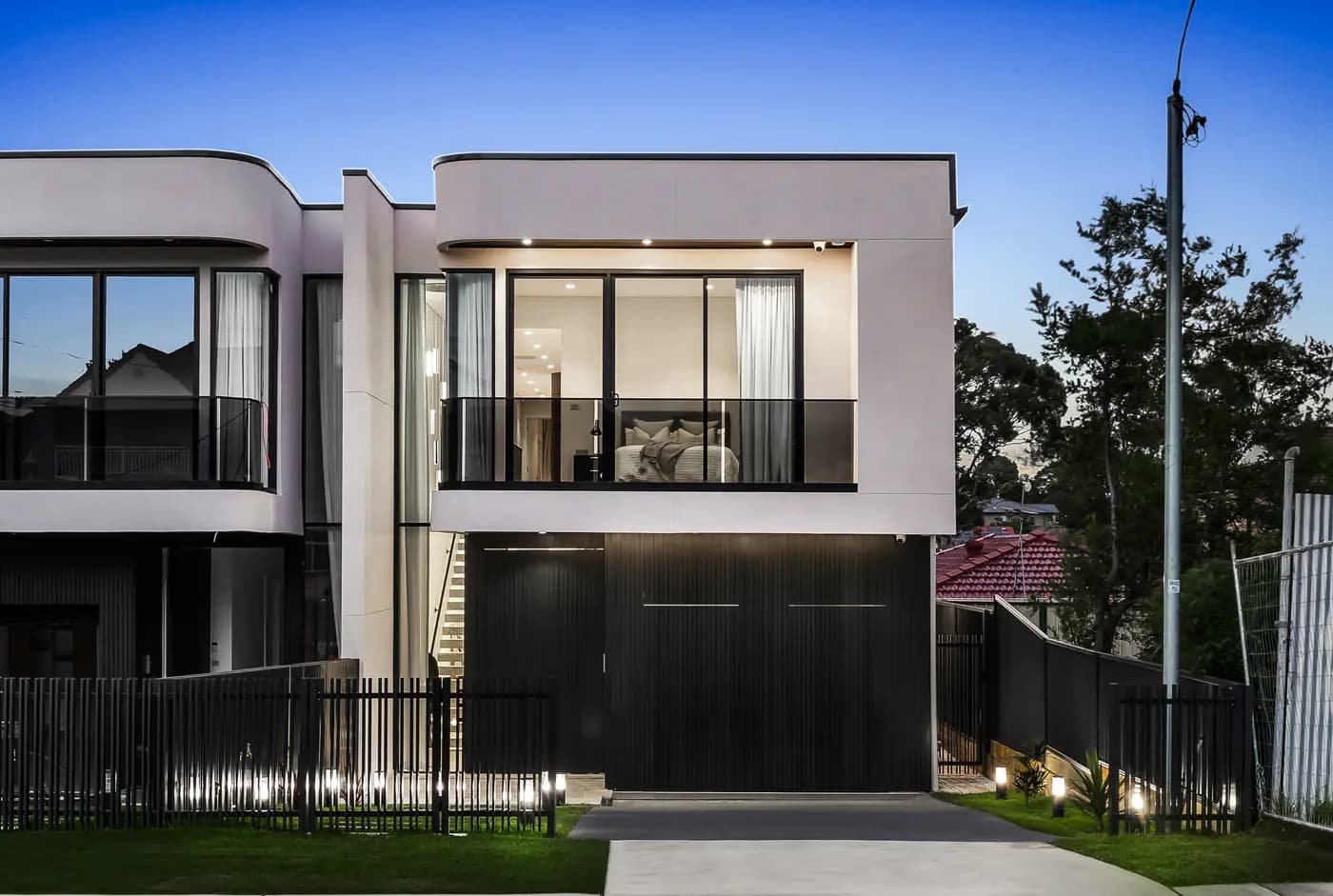
Site purchase: $1,025,000 (existing 1970s fibro on 580sqm R3 lot) Stamp duty paid at settlement: $41,684 Surcharge purchaser duty: $0 (Australian citizens, no trust) Land tax during 14-month build (PPOR broken for one year): ~$1,800 Conveyancing legal fees: $2,400
Total duty + tax cost on the KDR transaction: $45,884
Compared to the new build cost of $880,000, that's about 5.2% of the build budget — and it has to be cash at settlement. This is the figure that consistently surprises clients who've modelled their KDR purely from the construction quote.
For the build cost side of the equation see /insights/knockdown-rebuild-cost-sydney. For pathway and timeline see /insights/knockdown-rebuild-month-by-month-timeline-sydney. For pre-purchase site assessment so you know whether the block actually supports a profitable KDR — call 0476 300 300 or visit /homes/knockdown-rebuilds. We'll review the contract structure with you before you sign and flag any aggregation risk that your conveyancer might miss.
*Disclaimer: This is general practitioner commentary, not tax or legal advice. Stamp duty and land tax rules change — confirm current rates with Revenue NSW (revenue.nsw.gov.au) and engage a qualified solicitor and tax adviser for your specific transaction.*