Why sloped sites are where most fixed-price contracts break
A flat site is a site where the build matches the brochure. A sloped site is a site where the build matches reality. The brochure number — the $/m² rate from the project home builder — assumes 0.5m total fall across the lot. Anything more is variation territory.
In the Sydney metro, sloped sites are not the exception. They are most of the inventory. Hunters Hill, Hornsby, Ku-ring-gai, Northern Beaches, North Sydney, Sutherland, Camden Hills, parts of Penrith, parts of Liverpool — the median lot has 1.5–4m of fall across a typical 600–900m² block. Each metre of fall above 0.5m adds engineering, retaining, drainage and access cost that wasn't in the brochure quote.
The specific numbers below are 2026 Sydney metro figures, anchored to Rawlinsons Edition 29 Sydney column rates and adjusted for current siteworks contractor pricing.
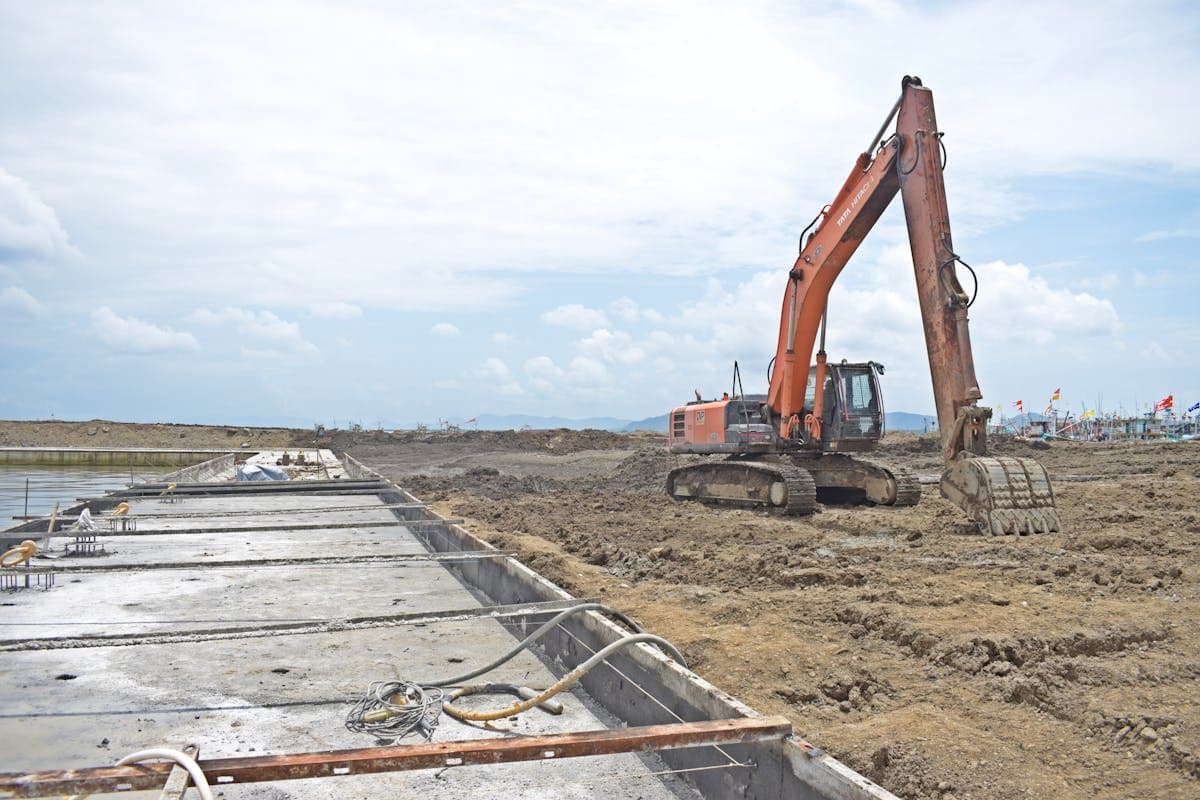
Cut and fill — the unit costs
Bulk earthworks for residential KDR or duplex in 2026:
Cut to remove (export off-site). $58–$92 per cubic metre depending on access, distance to spoil tip, and contamination. Sandstone or rock cut with rip-and-stack methods runs $140–$240/m³. Hammer or chip rock removal $260–$450/m³.
Fill placed and compacted. Imported clean fill $42–$68/m³ delivered and compacted in 200mm lifts. Site-won fill (cut redistributed) $28–$44/m³ for double-handling and compaction. Fill must achieve 95% standard Proctor density for slab support — testing required at $180–$320 per pad.
Cut-to-fill balance. The cheapest job is one where cut volume equals fill volume and nothing leaves site. Most sloping sites don't balance — the architectural floor level rarely matches the natural site contour. Excess cut goes off-site at the export rate; excess fill comes in at the import rate. Both cost money.
A typical 1.5m fall block needing 80m³ of cut and 60m³ of fill costs $5,800–$9,600 in pure earthworks before any retaining wall, drainage or compaction testing. A 3.5m fall block on the same footprint can run $26,000–$48,000 in earthworks alone.
Need a builder who actually communicates?
Weekly progress photos, dedicated PM, fixed-price contract. That's how every Buildana project runs.
Retaining walls — when they're structural and when they're cosmetic
Two categories that builders sometimes blur:
Structural retaining. Holds soil pressure to allow the building or driveway to sit at the planned level. Requires engineer's certification, council approval (often DA-triggering above 600mm in some LGAs), drainage detail and articulated joints.
Cosmetic retaining. Below 600mm, low-load, decorative. Can usually proceed without engineer's certification subject to council policy.
2026 Sydney rates installed:
• Reinforced concrete sleeper retaining (timber or concrete sleepers between galvanised steel posts): $480–$720 per linear metre at 1.0m height; $720–$1,100/m at 1.8m; $1,100–$1,650/m at 2.4m. Add $180–$280/m for engineer's certification on structural runs.
• Block retaining (Boral Allan Block, Versaloc, similar): $560–$840/m at 1.0m; $880–$1,280/m at 1.8m; $1,350–$1,950/m at 2.4m. Includes geogrid reinforcement at heights above 1.2m.
• Sandstone block (recycled or new): $720–$1,150/m at 1.0m; $1,350–$2,100/m at 1.8m. Premium look on Hunters Hill, Mosman, Hornsby Heights jobs.
• Concrete retaining (poured-in-place, formed, reinforced): $980–$1,650/m at 1.0m; $1,650–$2,650/m at 1.8m; $2,650–$3,950/m at 2.4m. Engineering and formwork heavy.
A 3m-fall block typically needs 25–40m of retaining, and the wall budget runs $35,000–$110,000 depending on system selected and engineering load.
Driveway and access — the silent cost driver
On a steep block, the driveway costs more than most owners realise.
Driveway slope limits. Australian Standard AS 2890.1 caps internal driveway slopes at 1:8 (12.5%) for residential. Above 1:6 (16.7%) requires transition zones at the top and bottom. Some councils impose tighter limits (Hornsby, Ku-ring-gai, Hunters Hill) — 1:10 or 1:12 maximums.
Driveway construction methods on slopes. Plain concrete drive at 1:10 grade: $115–$185/m². Stamped or coloured concrete: $160–$240/m². Exposed aggregate: $145–$220/m². Stone-paved: $280–$480/m². On grades above 1:8, cross-grooves or non-slip finishes are typically required and add $35–$55/m².
Stormwater on slope. A driveway dropping 4m needs intermediate spoon drains, kerb-and-channel detail, and a connection to council main or a soakage pit. Stormwater on a steep block: $4,800–$11,500 typically.
Crossover. Council-controlled. New crossover for steep blocks $3,200–$6,800 depending on width, materials, and council schedule of rates.
A 30m driveway on a 4m-fall block with proper drainage and a code-compliant crossover commonly hits $48,000–$75,000 in 2026. Most sub-$80k 'siteworks' allowances on quoted KDRs don't include this.
The contour survey — $1,200 that prevents $80k variations
Before you sign anything on a sloped block:
Commission a contour survey. $900–$1,400 for a residential lot, surveyor licensed and registered. Returns 0.5m contour lines, spot heights, services, vegetation, neighbouring building heights, fence lines and council title boundaries. Forms the base for the architect's site plan and the engineer's footing design.
Reject any contract priced before the contour survey. A builder pricing siteworks on a sloped site without a current contour survey is either guessing low to win the job or planning the variation chain that will hit you in months 4–7. Either way, walk.
Get earthworks priced as a separate trade. The earthworks contractor should quote against the contour survey directly, not as a $/m² inclusion in the headline build figure. If your builder won't break out the earthworks line, ask why.
Get retaining priced per linear metre per height range. The retaining schedule should show the specific length and height of each wall — not a single 'retaining allowance' lump sum.
For a free pre-signature siteworks read on any sloped Sydney block, call 0476 300 300 or visit /tools/feasibility-check. We turn away a meaningful number of jobs at the contour-survey stage where the slope-cost reality kills the feasibility.