Can You Airbnb a Granny Flat in NSW? The 2026 Reality
Short answer: not the way most people think. A granny flat in NSW is a secondary dwelling under the State Environmental Planning Policy (Housing) 2021. It exists for housing — not hotel substitution. The Short-Term Rental Accommodation (STRA) regime under the Housing SEPP and the Fair Trading Act sits on top, and there's a register, day-caps, and council overlays that change LGA by LGA.
If you're planning to build a granny flat and run it on Airbnb, read this before you sign the contract. The gross numbers can look better than long-term rental on paper. The compliance, vacancy reality, and lender treatment are all different — and most owners I see haven't run the actual math.
The STRA Register and the 180-Day Cap
Since November 2021, all short-term rental accommodation in NSW must be registered on the NSW STRA Register (planning.nsw.gov.au). Registration is annual, currently $65, and the property gets a unique STRA ID that has to appear on every Airbnb/Stayz listing.
The critical rule for hosted vs non-hosted:
• Hosted STRA (you live on site): unlimited nights • Non-hosted STRA in Greater Sydney: 180 nights per year cap
A granny flat where the host lives in the main house counts as hosted — no day cap. A granny flat where you don't live on site is non-hosted — capped at 180 nights, which is roughly half the year. That changes the yield model dramatically.
Council-by-Council Overlays — Where the Rules Tighten
The state cap is 180 nights. Some councils have argued for tighter caps in their LGAs through DCPs and planning proposals. Your job is to check the specific LGA at lodgement.
For Western Sydney where Buildana operates:
• Fairfield, Liverpool, Cumberland, Canterbury-Bankstown, Blacktown — currently the state 180-night cap applies for non-hosted; no LGA-specific tightening at April 2026 • Inner Sydney LGAs (Sydney City, Waverley, Randwick) — same cap but enforcement is much tighter
If council later tightens the rule mid-build, you keep the right to register but the day cap may change. Don't assume permanence. Plan the investment with downside.
Want a real granny flat price for your backyard?
Fixed-price granny flats from Buildana. We'll price YOUR block — not a generic range.
The Gross-vs-Net Trap on Short-Stay
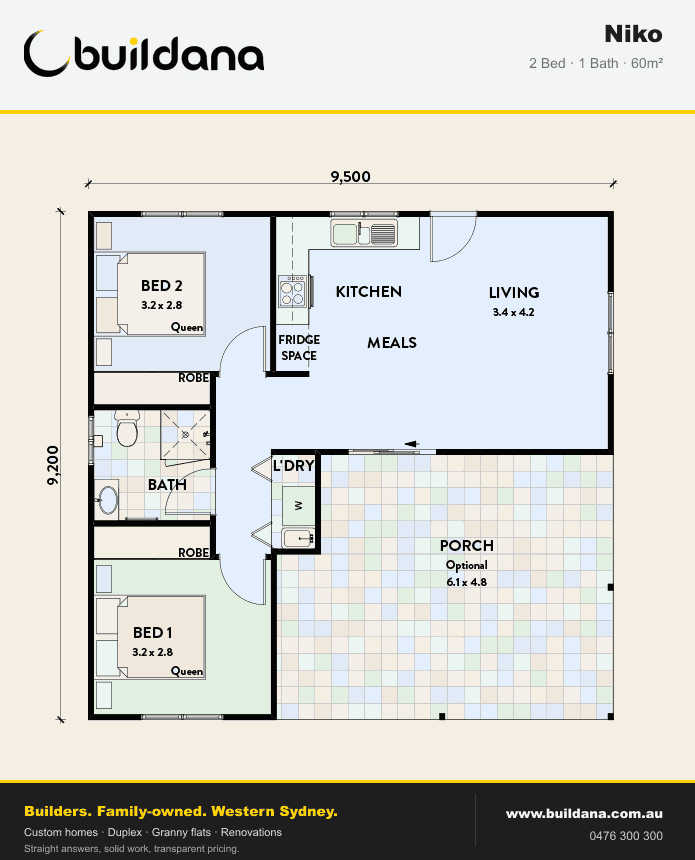
Owners get sold the gross nightly rate. Let's run the actual math on a 60sqm 2-bed in Liverpool:
Long-term: $510/week × 50 weeks = $25,500/year gross.
Short-stay non-hosted (capped at 180 nights): • Average daily rate: $180 • Occupancy on available nights: 65% • Booked nights: 180 × 0.65 = 117 • Gross revenue: 117 × $180 = $21,060/year
Non-hosted short-stay loses on both fronts — capped nights AND lower-than-expected occupancy. And that's before you take out:
• Cleaning (per turnover): $80–$120 × ~80 turnovers = $6,400–$9,600 • Linen/consumables: $1,200/year • Platform fees (Airbnb host: 3%, guest service): ~$700 • Property manager (if used) 15%–20%: $3,000–$4,200 • Insurance uplift for STRA: $400–$700 extra/year • Higher wear-and-tear (turnover at 47x the rate of long-term): repaint every 3 years not 7
Net on non-hosted STRA frequently lands below long-term rental. The exception is hosted (no cap, lower management cost) where the host genuinely lives on site.
Where Short-Stay Actually Makes Sense
Short-stay works for granny flats when all three are true:
1. Hosted (you live in the main dwelling) — uncapped 2. High-tourism micro-location (near hospital for medical stays, near a major event venue, near a university for visiting academics) 3. Premium fit-out you can charge a real ADR for ($220+ a night)
Western Sydney examples that work: granny flats near Liverpool Hospital (medical families), near Sydney Showground at Olympic Park during event seasons, near Western Sydney University Bankstown campus for visiting academics. These pull repeat 2–6 week stays — closer to a serviced apartment than a hotel substitute.
If your motive is purely yield without those conditions, build for long-term tenancy. The numbers are stronger and the maintenance is sustainable.
Fixed-price estimate
Get a real number for your block
Two minutes now saves the guesswork. Oliver or one of the team calls back with a realistic range for your suburb and block, then books a free site walk if you want a fixed price.
- Priced off your block, not a brochure — soil, slope and council read first
- NSW licensed builder 487805C. HBCF insured. Fixed-price HIA contract.
- Reply within 4 working hours. No sales pressure, ever.
What to Check Before You Build for STRA
Pre-build checklist if STRA is your endgame:
• Confirm hosted vs non-hosted with your lender — some lenders now restrict STRA-zoned debt or apply a 60% rent shading • Run a real ADR/occupancy model from AirDNA or PriceLabs for your specific suburb (don't trust agent forecasts) • Allow $5k–$8k extra in fit-out for STRA-grade durability — commercial-grade flooring, easy-clean tile, sealed benchtops • Add an STRA condition into the building contract: insulation upgrade, deadlocks, smoke alarms wired and inter-connected, BCA-compliant egress • Budget $400/year for the NSW STRA registration plus annual renewal • Insure under a dedicated STRA policy (NRMA, Allianz, ShareCover) — standard landlord insurance excludes short-stay
For the underlying granny flat rules (lot size, setbacks, height) see /insights/granny-flat-rules-nsw-2026. For the design and approval side visit /homes/granny-flats or call 0476 300 300 to walk the block before any decision.
Once you know the rules, the next step is matching them to a layout that fits your block. Our full library of compliant granny flat designs sits at /homes/granny-flats/designs — 47 plans ranging from 35m² studios up to 60m² 2-bedroom units, all sized to NSW SEPP requirements.
2026 Short-Stay Rules — Where Granny Flats Stand
The NSW short-stay rental accommodation register and the 180-day cap for non-hosted short-stays remain in force through 2026. The practical implications for a granny flat in our service area:
• Granny flats are 'secondary dwellings' under the Housing SEPP 2021. The Affordable Rental Housing SEPP (now Housing SEPP) explicitly permits letting granny flats to any tenant on a residential tenancy — but the short-stay regime is governed by separate state-wide and council-level rules.
• Hosted vs non-hosted short-stay. If you live in the principal dwelling on the lot, your granny flat short-stay is 'hosted' (because you're on-site) — and hosted short-stay accommodation is exempt from the 180-day cap state-wide. If you live elsewhere and short-stay the granny flat (and possibly also the principal house), it's 'non-hosted' — and the 180-day cap applies in Sydney metropolitan local government areas.
• Council overlays. Some councils have additional controls on short-stay accommodation in residential zones. As of May 2026, the LGAs we work in (Fairfield, Liverpool, Cumberland, Canterbury-Bankstown, Blacktown) all defer to the state-wide framework — no additional LGA-level caps. Inner-city Sydney councils (City of Sydney, Inner West, Waverley) apply tighter rules. Check the s10.7 planning certificate for your specific lot.
• Registration. All short-stay properties must be on the NSW STRA register. Registration is straightforward and online. Strata-titled granny flats (rare) face additional restrictions through by-laws.
• Insurance and tax. Standard landlord insurance doesn't cover short-stay. You need short-stay-specific cover ($800–$2,000/year typical). GST registration may apply once turnover exceeds $75k/year — get an accountant view before going operational.
• Permissibility risk. If a granny flat is approved as a 'secondary dwelling' and then used predominantly for short-stay accommodation, some councils have argued it constitutes a change of use to 'tourist and visitor accommodation' — a different land use class with different planning requirements. This argument hasn't been broadly tested in tribunal yet, but it's worth being aware of in 2026.