
Lidcombe 2141 · Cumberland and Parramatta
Granny Flat Builders in Lidcombe: The Code Rules, Explained Simply
Granny flat rules, minus the jargon.
Lidcombe's 450 to 650 square metre lots and its station make it good granny flat country. Whether yours gets the quick certifier approval or goes to council comes down to a handful of state rules. Here they are in plain English, with the things that commonly knock a lot out.
Short answer
What are the granny flat rules in Lidcombe?
Under the state code, a lot generally needs at least 450m² and 12m width at the building line, and the flat can be up to 60m², with setback and height limits on top. If it passes, a certifier can approve it within weeks; flood mapping or other constraints mean a Cumberland DA of 10 to 14 weeks. Flats here rent for about $400 to $530 a week.
Written and reviewed by Oliver Alameri
Licensed builder, NSW Contractor Licence 487805C · Founder, Buildana
Fact-checked
The core tests
The quick route is the state's Housing SEPP code. A private certifier checks the design against a fixed set of rules and, if it passes, approves it, usually within a few weeks. Neighbours get 14 days' written notice first, but there's no merit debate.
The headline tests: the lot has to measure at least 450 square metres, and be 12 metres or more across where the house sits. The flat itself is capped at 60 square metres of floor area. One secondary dwelling per lot, and the main house stays on the same title.
Height, setbacks, garden area and outdoor living space each have their own numbers too. Pass every one and it's a certifier job. Miss one and it's a DA with council.
- Site of 450m² or bigger
- 12m or more across at the building line
- Granny flat floor area no more than 60m²
- Height, setback, landscaping and open-space controls all met
- Main house and flat stay on one title
The code doesn't negotiate. It's pass or fail on every line.
Setbacks and height, in rough terms
On a typical Lidcombe lot between 450 and 900 square metres, the code generally allows a side setback of about 900 millimetres and a rear setback of around 3 metres, with larger lots needing more. Height is capped at 8.5 metres, which a single-storey flat never gets near.
There are extra rules for things like windows facing neighbours, and for how much of the lot must stay as garden. The main house also can't lose too much of its own backyard once the flat goes in.
Those are summaries, not a substitute for the code itself. A certifier checks the actual numbers against your survey, and so do we before design is finalised.
Does your lot pass the code?
Pass on the Lidcombe address, plus any survey you already hold. I'll run it against every code test and tell you whether it's a certifier job or a DA, with a fixed price for the flat.
0476 300 300What commonly knocks a lot out
Some land can't use the code at all, or only with extra conditions. Heritage items and conservation areas. Some flood-affected land, which matters near Duck River. The two top bushfire categories, BAL-40 and flame zone. Certain environmentally sensitive areas.
Other lots fail on a detail: slightly under 12 metres wide, a sewer main where the flat needs to go, or an existing house that already uses up too much of the lot. None of those mean no granny flat. They mean a DA instead, which in Cumberland typically takes 10 to 14 weeks.
And remember Lidcombe is split between Cumberland and Parramatta councils. For a DA, it matters which one you're in.
Cost and what the flat can earn
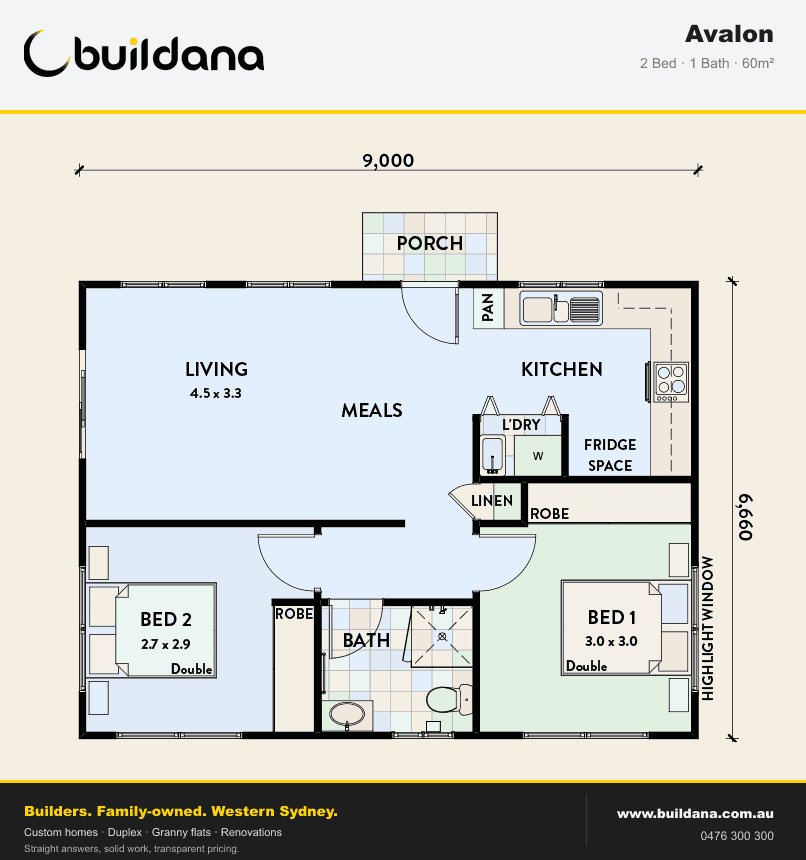
With Cumberland's 1.07 factor on Rawlinsons Sydney rates, mid-spec construction comes to about $2,350 to $2,840 a square metre. A compact flat costs more per square metre than a big house because the kitchen and bathroom are packed into a small area.
Granny flats around Lidcombe rent for roughly $400 to $530 a week, helped by the trains and the Olympic Park jobs next door.
Quick self-check for your Lidcombe lot
If you can tick all six, the code route is likely open.
- 01
Site area of 450m² or more
- 02
At least 12m across at the building line
- 03
Neither a heritage item nor inside a conservation area
- 04
Not flood-affected in a way that excludes the code
- 05
No sewer main or easement where the flat needs to sit
- 06
The existing house leaves enough garden and outdoor space
Granny flat rules questions
How small a lot can take a granny flat in NSW?
For the Housing SEPP code route, 450 square metres, and 12 metres wide where the house sits. Smaller lots may still get one through a council DA in some cases.
What's the largest granny flat allowed?
Sixty square metres of floor area under the state rules, unless a local plan permits more through a DA.
What does 'CDC approved' mean for a granny flat?
It means the design met every standard in the state code, so a private certifier issued a complying development certificate. Council never assessed it as a DA.
Can I get a granny flat if my lot is flood affected?
Sometimes. Some flood-affected land can't use the code or has extra conditions, so it may need a DA. Your lot's 10.7 certificate will say.
Sources and references
Costs are from the Rawlinsons handbook with the local cost index applied; rules and timeframes are checked against the sources below.
- Cumberland City Council
- Rawlinsons Australian Construction Handbook, Rawlhouse Publishing
- Environmental Planning and Assessment Act 1979 (NSW)
- State Environmental Planning Policy (Exempt and Complying Development Codes) 2008
- State Environmental Planning Policy (Housing) 2021
- Building on bush fire prone land, NSW RFS
- Search heritage databases, NSW Environment and Heritage
- NSW Planning Portal Spatial Viewer (zoning, FSR and hazard maps)
Know if you pass before you pay a designer.
A quick check of your Lidcombe lot against the code saves weeks and money.