How Slope Affects Your Build
In Sydney's varied topography, many residential lots have some degree of slope — from gentle falls of 1–2% to steep gradients of 20%+ in some suburbs. The slope of your land directly impacts foundation design, excavation costs, retaining wall requirements, driveway gradient, drainage management, and ultimately your total build cost.
Sloping land is measured as the height difference between the highest and lowest points of the building footprint, expressed as a percentage of the horizontal distance. For example, a 2-metre fall over a 20-metre deep lot = 10% slope.
Slope categories and their impact:
• Flat to gentle (0–5%): Minimal additional cost. Standard slab-on-ground construction. Most Western Sydney lots in Fairfield, Liverpool, and Canterbury-Bankstown fall in this range.
• Moderate (5–10%): Noticeable cost increase. May require cut and fill, stepped slab, or retaining walls. Common in parts of Cumberland, Blacktown, and eastern Liverpool.
• Steep (10–20%): Significant cost impact. Split-level or fully suspended construction likely. Substantial retaining walls required. Engineering complexity increases.
• Very steep (20%+): Major engineering challenge. Pier and beam foundations, extensive retaining, complex access for construction vehicles. Cost premium can exceed $150,000.
The critical message is this: buying a sloping block at a discount doesn't always save money if the additional construction costs exceed the land price discount. Buildana provides free site assessments that include preliminary slope analysis and cost impact estimation — giving you real numbers before you commit to purchasing.
Cut and Fill vs Split Level vs Suspended
There are three main construction approaches for sloping sites:
1. Cut and fill: The site is excavated (cut) on the high side and the excavated material is used to fill the low side, creating a level pad for a conventional slab-on-ground. This is the most cost-effective approach for moderate slopes.
• Typical cost: $15,000–$50,000 for earthworks (depending on volume, rock, and disposal requirements) • Additional cost for retaining walls: $5,000–$30,000 (to retain the cut face and fill edge) • Suitable for: Slopes up to 10–12% • Advantages: Standard slab construction, single floor level throughout, traditional house design • Disadvantages: May require imported or exported fill, compaction testing adds time, doesn't take advantage of views from improved position
2. Split-level design: The home is designed in two or more sections at different levels, following the natural slope. Each section has its own slab at a different height, connected by internal stairs. This reduces earthworks by working with the slope rather than against it.
• Typical cost premium over flat site: $25,000–$60,000 (reduced earthworks but more complex slab, multiple levels, additional stairs) • Suitable for: Slopes of 8–20% • Advantages: Reduced earthworks, interesting architectural design, preserves natural drainage, can capture views from multiple levels • Disadvantages: Internal stairs between zones (not ideal for accessibility), more complex construction, requires experienced builder
3. Suspended (improved/pier) construction: The home is built on piers or posts with the floor suspended above the natural ground level. The underfloor space can remain open (enclosed for storage or converted to habitable space in some cases).
• Typical cost premium: $50,000–$150,000+ (pier foundations, suspended slab or timber floor, subfloor enclosure) • Suitable for: Slopes of 15%+, or sites where cut and fill would require enormous retaining walls • Advantages: Minimal site disturbance, preserves natural drainage, underfloor space for storage/utilities, often creates dramatic architectural forms • Disadvantages: Most expensive option, complex engineering, longer construction timeline, potential underfloor maintenance
Buildana assesses every sloping site to determine the most cost-effective construction approach. Sometimes the answer is obvious; other times we model two or three options with real cost comparisons so you can make an informed decision.
Need a builder who actually communicates?
Weekly progress photos, dedicated PM, fixed-price contract. That's how every Buildana project runs.
Retaining Wall and Drainage Costs on Slopes
Retaining walls are the biggest single cost driver on sloping sites. A flat-site home might require no retaining at all, while a sloping site might need $40,000–$80,000+ in retaining walls and associated drainage.
Typical retaining requirements by slope:
5–10% slope: • One boundary retaining wall (1.0–1.5m height): $5,000–$15,000 • Backyard level change wall: $3,000–$8,000 • Driveway cut retaining: $2,000–$5,000 • Total retaining: $10,000–$28,000
10–15% slope: • Two or more boundary retaining walls (1.0–2.5m heights): $15,000–$40,000 • Terraced backyard (two or three levels): $8,000–$20,000 • Driveway cut with engineered wall: $5,000–$12,000 • Total retaining: $28,000–$72,000
15–20%+ slope: • Major engineered retaining (2.0–3.5m heights): $30,000–$80,000 • Terraced outdoor areas with structural walls: $15,000–$30,000 • Access road/driveway construction: $10,000–$25,000 • Total retaining: $55,000–$135,000
Critical drainage elements for sloping sites: • Subsoil drainage (ag-pipe) behind all retaining walls: $30–$60/lm • Surface drainage (concrete channels or slot drains): $80–$150/lm • Stormwater management system (inter-allotment drainage or charged system to street): $3,000–$8,000 • On-site detention (OSD) tank or chamber: $5,000–$15,000 (required by most Western Sydney councils)
Water management on slopes is not optional — it's the difference between a stable, well-drained site and one that develops erosion, foundation movement, and retaining wall failure within years. Buildana includes full drainage design in every sloping-site project.
Driveway Design on Sloping Blocks
The driveway is often the most challenging element of a sloping-site build. Council requirements and practical considerations include:
Maximum driveway gradient: • Most Western Sydney councils: maximum 1:5 (20%) for residential driveways • Transition zones at top and bottom (where the driveway meets the garage floor or the street): maximum 1:8 (12.5%) for at least 2 metres to prevent scraping • Some councils (e.g., Liverpool) allow steeper grades with textured surfaces
Driveway construction on slopes: • Concrete with broom or exposed aggregate finish is standard — pavers are not recommended on steep driveways due to shifting risk • Minimum width: 3.0m for single car, 5.5m for double car • Edge retaining may be required if the driveway cuts through the slope • Drainage grate at the bottom of sloping driveways to prevent water entering the garage
Cost comparison — flat vs sloping driveway: • Flat site driveway (50sqm, exposed aggregate): $4,000–$6,500 • Moderate slope driveway (50sqm, with cut, retaining, and drainage): $8,000–$15,000 • Steep slope driveway (extended length, retaining both sides, textured finish): $15,000–$30,000
Design strategies for steep driveways: 1. Curved approach: Instead of a straight, steep driveway, a curved path along the contour reduces the effective gradient 2. Garage at street level: On down-slope blocks, place the garage at the street level and build the home below — accessed via internal stairs or a lift 3. Underbody clearance: For driveways with transition humps, consult with your builder about vehicle clearance — particularly for low-profile cars 4. Heated driveway: In rare cases, slip-prone steep driveways benefit from in-slab heating to reduce algae growth (more common in high-rainfall areas)
Buildana designs driveways as an integral part of the home — not an afterthought. On sloping sites, driveway design often starts before the floor plan because the vehicle entry point and garage location dictate the entire building layout.
Making the Most of a Sloping Block
Despite the additional costs, sloping blocks offer genuine advantages that flat blocks cannot:
1. Views: improved positions provide district, city, or bushland views. In suburbs like Moorebank, St Clair, and parts of Cumberland, a sloping block can deliver views that add $50,000–$200,000 to the property's value.
2. Architectural interest: Split-level and improved designs are inherently more visually dramatic and architecturally interesting than flat-site homes. These homes photograph beautifully and attract premium buyers.
3. Separation of zones: The natural level change allows a clear separation between living zones (upper level with views) and sleeping zones (lower level with garden access) — or between adult spaces and children's spaces.
4. Underbody storage: Suspended or split-level construction creates underfloor spaces perfect for storage, workshop areas, or even wine cellars — all without consuming above-ground floor area.
5. Natural drainage advantage: Properly managed, water flows away from the building on a sloping site more naturally than on a flat site, reducing the risk of foundation moisture issues.
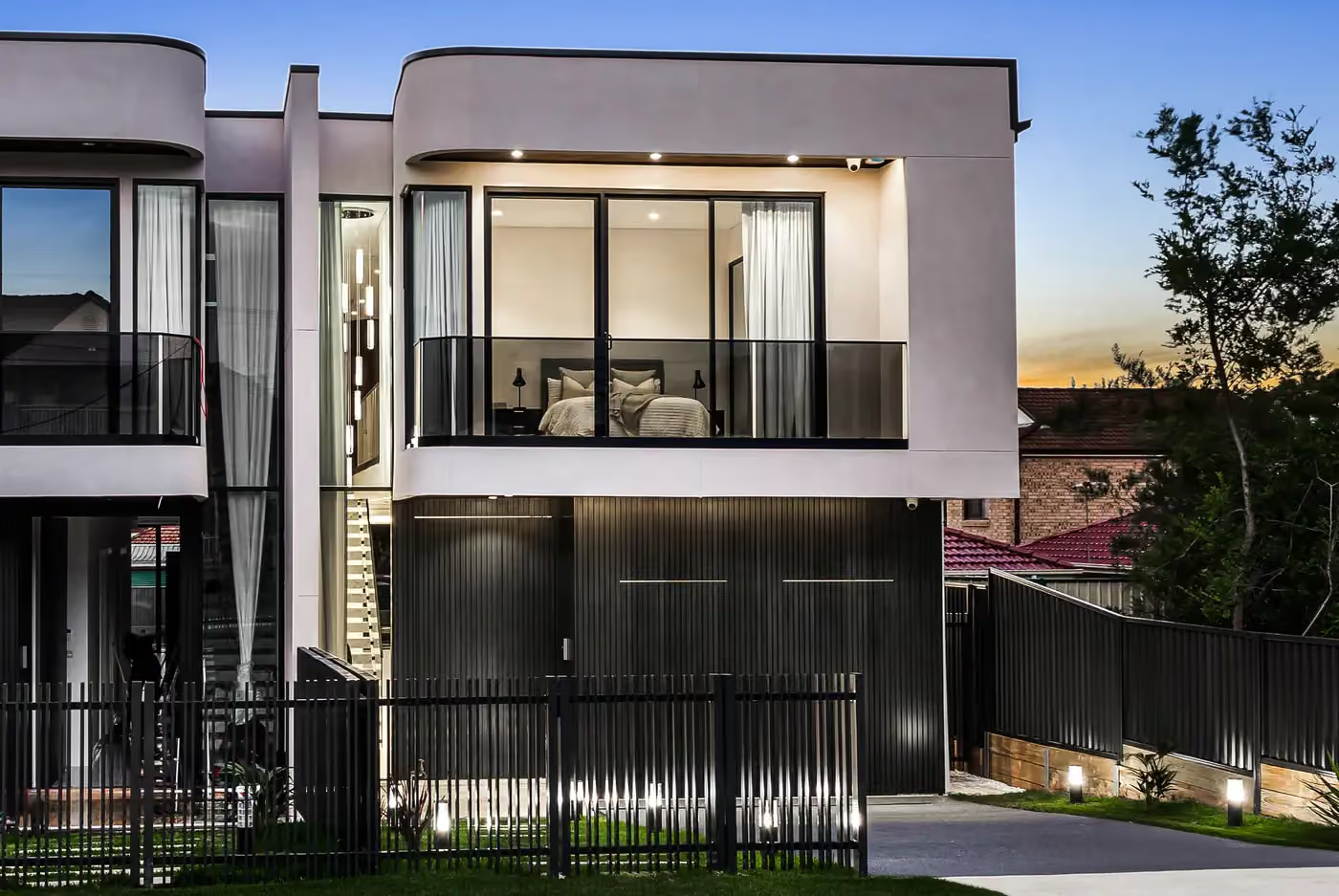
Real project example — Fairfield Heights: Buildana recently completed a two-storey custom home on a 12% slope in Fairfield Heights. The design used a split-level approach with a cut-and-fill pad for the garage and upper living level, and a suspended lower bedroom level that captured district views.
• Land cost: $980,000 (10% below comparable flat blocks in the area) • Slope-related cost premium: $65,000 (retaining, earthworks, suspended slab) • Completed home value: $2,150,000 • Net benefit of buying the sloping block: approximately $105,000 in additional equity
Sloping blocks are not for every builder — they require experience, engineering capability, and construction expertise. Buildana has completed residential projects on slopes up to 25% across all five Western Sydney LGAs. Call 0476 300 300 for a free sloping-site assessment.
Buildana builds across Sydney. Visit /advisory/value-engineering to learn more or /contact to discuss your project.