What the Bank Actually Adds to Your Valuation
Average uplift across the granny flats Buildana (Lic. 487805C) has built in Fairfield, Liverpool, Cumberland and Canterbury-Bankstown: $80,000-$160,000 against a build cost of $150,000-$210,000.
Meaning: the bank values 40-85% of your build cost as additional property value. The other 15-60% is 'used up' on construction value that doesn't translate to dollar-for-dollar market price.
The spread is wide because valuations depend on rental cash flow, comparable sales, finish level, and whether the dwelling has a clean approval trail. Granny flats with sloppy paperwork get valued at $60k. Granny flats with CDC, OC, and a tenancy in place get valued at $150k+.
What Drives the Uplift
Rental income evidence. Banks use the actual lease rate (or a market-rent assessment from the valuer) to back into a value. Higher weekly rent = higher valuation. A 2-bed at $480/week in Fairfield will value at $20k-$30k more than the same 2-bed at $400/week.
Quality of construction. Brick veneer or full brick with a Buildana-grade finish carries through to valuation. Cheap timber-frame with vinyl cladding gets discounted.
Separation and metering. Own electrical meter, own hot water, own letterbox, own driveway access. Banks treat this as 'genuine secondary dwelling' rather than 'rumpus with a kitchen'.
Compliance trail. CDC or DA approval + structural engineer cert + plumbing cert + final Occupation Certificate. Without the OC, the valuer is conservative.
LGA fundamentals. Fairfield, Liverpool, Bankstown values are all rising faster than the Sydney median in 2026 — granny flat valuation upside benefits from the suburb tailwind.
Want a real granny flat price for your backyard?
Fixed-price granny flats from Buildana. We'll price YOUR block — not a generic range.
Compliant vs Non-Compliant — The Valuation Gap
Compliant granny flat (CDC + OC + separately serviced): • Valued at full secondary dwelling value. • Adds $80k-$160k to property valuation. • Bank lends against full new valuation for refinance.
Non-compliant 'studio' (no approval, no OC, services off main house): • Valued as 'improved garden shed' or 'rumpus area'. • Adds $20k-$50k at best. • Bank may refuse to recognise it as habitable space, or may require demolition before refinance approval. • Insurance is patchy. Risk if it burns down or causes flood damage.
The $60k-$110k valuation gap between compliant and non-compliant is bigger than the CDC + documentation cost ($5k-$8k). Cutting corners on approval to save $5k loses you $60k+ in valuation. Maths is brutal.
5-Year Total Return — Income Plus Capital
Scenario: 2-bed granny flat in Fairfield, build cost $185,000, rented at $440/week.
Year 1: • Rent: $440 × 52 = $22,880. • Valuation uplift: $130,000. • Notional year-1 return on $185k build: 82.6%.
5-year stack (assume 3% annual rent growth, 5% annual capital growth on the new valuation): • Cumulative rent: ~$155,500. • Cumulative capital gain on the granny flat component: ~$164,000. • Total: $319,500 on a $185,000 investment = 173% over 5 years.
Net of operating costs (council rates uplift, insurance increment, agent fee, vacancy allowance): roughly $40k-$55k off the rent over 5 years. Still leaves a real return well above any liquid asset class available to an average household.
This is why granny flats keep showing up in the top tier of capital-efficient property moves in Sydney. Contact Buildana for a free site assessment.
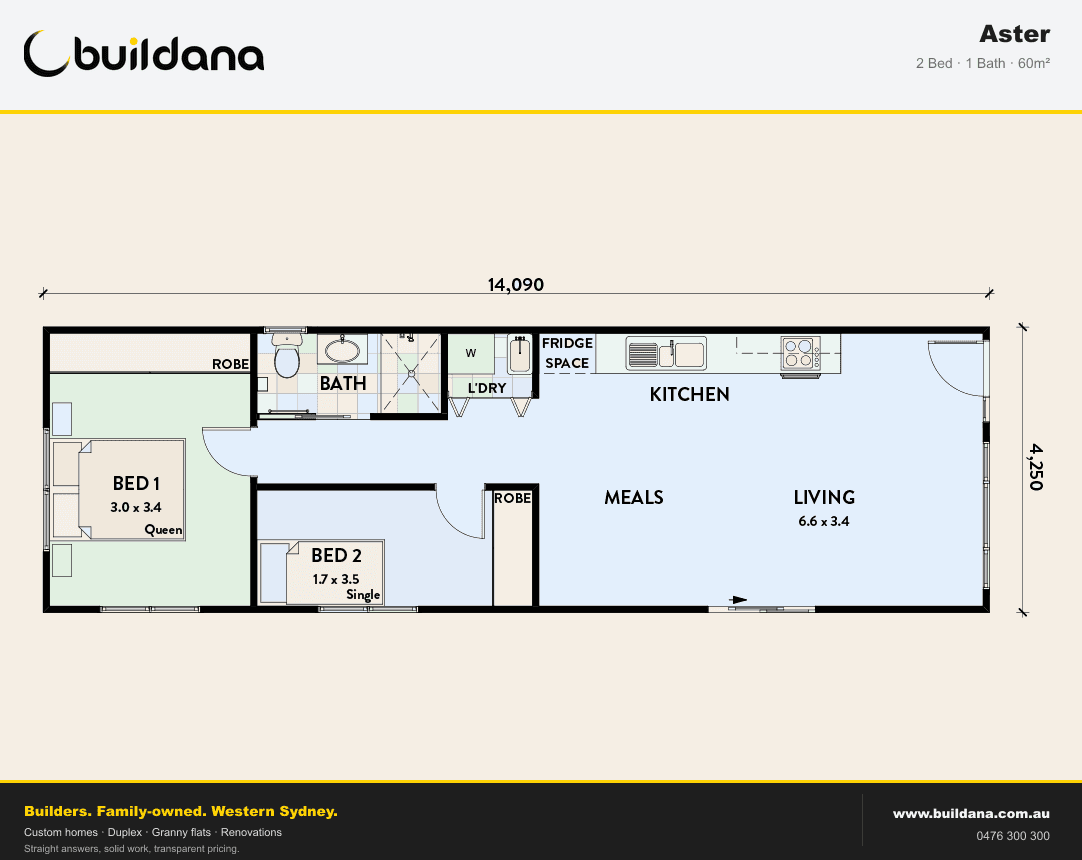
If the numbers stack up for your site, the next call is layout. Our 47 granny flat designs at /homes/granny-flats/designs are tagged by bedroom count and floor area so you can pick the plan that maximises rentable space without blowing the build cost.
May 2026 Property Value Uplift — What the Numbers Look Like
Adding a granny flat to an existing house lot adds value to the property on resale. The exact figure depends on the LGA, the existing house's land-to-improvements ratio, and whether the granny flat is Torrens-eligible (it isn't — granny flats can't be subdivided), but the May 2026 data across our five Western Sydney LGAs is consistent enough to share working numbers:
Typical value uplift from a 60sqm 2-bedroom granny flat (medium spec brick veneer, ~$220k all-in cost): • Fairfield: $150k–$210k uplift • Liverpool: $180k–$260k uplift • Cumberland: $180k–$240k uplift • Canterbury-Bankstown: $190k–$250k uplift • Blacktown: $170k–$240k uplift
The uplift is larger in the higher-rent LGAs (Liverpool, Canterbury-Bankstown) because the rental income story matters more to investor buyers, who form a meaningful portion of the buyer pool in our service area.
Why the uplift typically equals or exceeds the build cost: • A buyer is paying for a turn-key income stream — they don't have to wait 5–7 months for a granny flat to be built. That convenience is worth a premium. • The buyer pool widens. Existing-house + granny flat suits multi-generational families, investors, and house-hackers — three distinct buyer types vs the single-buyer pool for a house alone. • Bank valuations on completed granny flats are reasonably generous. Most lenders will value the granny flat at 80–100% of build cost for finance purposes, which translates to similar valuation outcomes on sale.
What erodes the uplift: • Cheap or visibly DIY granny flat construction. A $140k transportable on a $1.2M block reads as a liability, not an asset. • Awkward siting that blocks the principal dwelling's natural light or compromises the rear yard usability. • Shared services that aren't sub-metered (if utilities aren't separated, future tenants can't be billed independently).
Done well, a granny flat is one of the highest-return improvements you can make to a Sydney house. For the build cost view: /insights/granny-flat-cost-sydney.