Two Routes to More Rent — Which Fits Your Block?
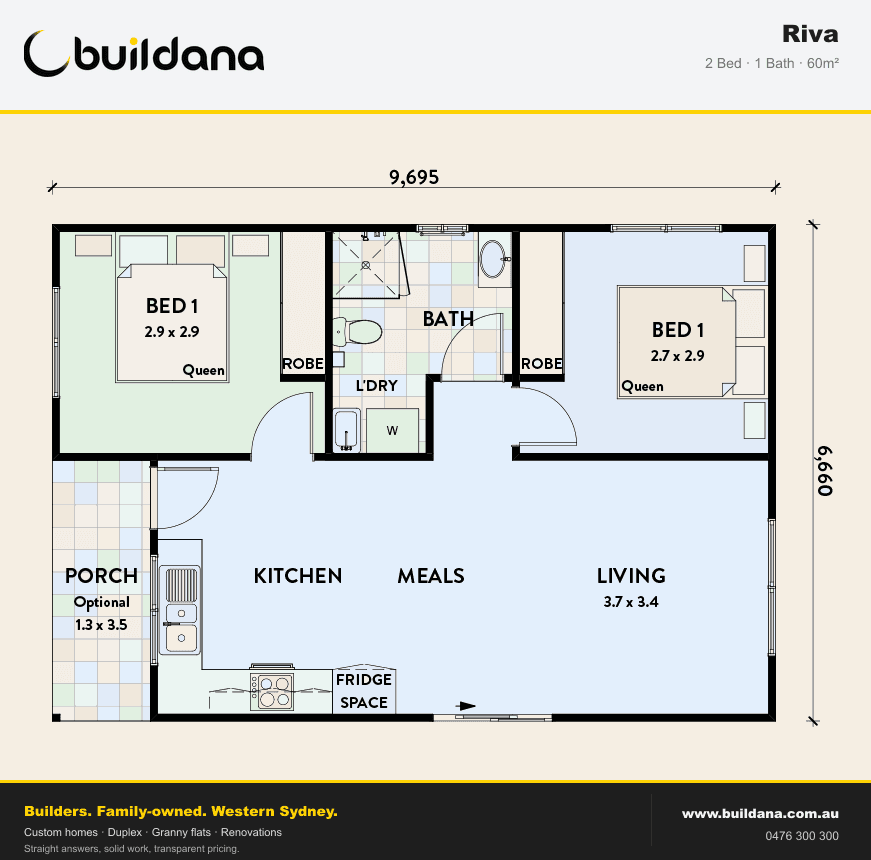
Granny flat: keep the existing house, build a 60 sqm secondary dwelling behind it. All-in $150,000-$210,000. 4-6 months from site visit to occupation certificate.
Duplex: demolish the existing house, build two attached dwellings on the same lot. All-in $750,000-$980,000. 14-20 months from site visit to occupation certificate.
Different scale, different risk profile, different exit options. Buildana (Lic. 487805C) builds both — about 30 granny flats a year, 12-15 duplexes. The decision usually comes down to four things: block qualification, capital available, timeline tolerance, and exit strategy.
Cost & Time
Granny flat: • Build cost: $150k-$210k all-in. • Approval: CDC 10-15 business days, total project 4-6 months. • Existing house keeps generating rent (if rented) or housing you during the build. • Construction risk: low. Standardised SEPP-compliant box.
Duplex: • Build cost: $750k-$980k all-in (Rawlinsons-anchored 2026 Sydney rates for medium-high spec brick veneer duplex). • Approval: CDC 4-8 weeks if eligible, otherwise DA 3-6 months. Total project 14-20 months. • Existing house demolished — 12+ months of zero rent if it was tenanted, plus alternative accommodation if you lived there. • Construction risk: medium. More trades, more sequencing, more variations possible. Soil class and stormwater are bigger swing factors at this scale.
Want a real granny flat price for your backyard?
Fixed-price granny flats from Buildana. We'll price YOUR block — not a generic range.
Returns — Income vs Capital
Granny flat (Fairfield, build cost $185k, 2-bed): • Additional rent: $400-$480/week = $20,800-$24,960/year. • Yield on build cost: 11-13%. • Property value uplift: $80k-$160k. • Can it be sold separately: no, it shares title with the main house.
Duplex (Fairfield, build cost $880k, two 3-bed dwellings): • Combined rent: $1,060-$1,300/week = $55k-$67k/year. • Yield on build cost: 6.5-8%. • Combined market value: $1.8M-$2.1M (depending on suburb and finish). • Can it be sold separately: yes, if the lot is subdivided (Torrens or strata).
Granny flat wins on yield. Duplex wins on absolute capital created and on the ability to crystallise that capital by selling one side. Different beast.
Block Qualification — Where Most People Get Stuck
Granny flat qualifying minimum: 450 sqm. Anything residential-zoned with R1/R2/R3 zoning and a reasonable shape qualifies.
Duplex qualifying minimum: varies by LGA, typically 600-700 sqm under standard SEPP. Subdivision into two Torrens lots usually needs 800 sqm+ with minimum lot sizes of 400 sqm each after subdivision.
Fairfield: duplex minimum 600 sqm, Torrens subdivision typically needs 800-900 sqm. Liverpool: duplex minimum 700 sqm, Torrens 900 sqm+ (varies by precinct). Canterbury-Bankstown: duplex minimum 600 sqm. Cumberland: duplex minimum 600-700 sqm depending on zone.
If your block is 450-599 sqm, you can do a granny flat but you cannot do a duplex. End of decision tree.
The Sequence Play
Some blocks support both — but not simultaneously. If you build a granny flat now and later want a duplex, the granny flat has to be demolished as part of the duplex build (the duplex consumes the whole site).
If you have a 700+ sqm block and the budget is currently capped at granny-flat money, the sensible sequence is often: 1. Build the granny flat now ($180k, 4-6 months). 2. Refinance the property in year 2-3 once the rental income is established and the valuation has caught up. 3. Use the refinanced equity (typically $80k-$140k released) as the deposit on a second site for a duplex build, or hold and reassess.
This is not for everyone — it requires comfort with debt and a second site purchase. But it spreads risk and starts compounding rent earlier than waiting to save the full duplex deposit.
Contact Buildana for a free site assessment. We will tell you which configurations your block actually qualifies for and what the rental and capital numbers look like on each.
If granny flat lands as the right call for your site, jump straight to the layouts at /homes/granny-flats/designs.