Pool Types and Price Ranges for Western Sydney
Western Sydney's hot summers make a pool one of the most desirable additions to a new or existing home. The three main pool construction types for residential properties are:
Fibreglass (pre-manufactured shell): A factory-moulded fibreglass shell is delivered to site and craned into an excavated hole. Available in a wide range of shapes and sizes from manufacturers like Compass Pools, Narellan Pools, and Freedom Pools. • Size range: 4m–12m length, 2.5m–4.5m width • Cost installed: $35,000–$75,000 (pool only, including excavation, crane, backfill, equipment) • Timeline: 2–4 weeks from excavation to swim • Best for: Standard-shaped pools, fast installation, low maintenance, tight access (narrow crane paths available)
Concrete (gunite/shotcrete): A fully custom pool built on-site from steel-reinforced concrete, finished with interior plaster, pebblecrete, or fully tiled. This is the premium option for those wanting a completely custom shape, size, depth profile, or integrated spa. • Size range: Unlimited — from 3m plunge pools to 15m+ lap pools • Cost installed: $60,000–$180,000+ (pool only) • Timeline: 8–14 weeks from excavation to swim • Best for: Custom shapes, infinity edges, large pools, integrated spas, natural stone surrounds
Plunge pools: Small, deep pools (typically 3m–5m long, 2m–3m wide, 1.4m–1.8m deep) designed for cooling off rather than swimming laps. Available in both fibreglass and concrete. • Cost installed: $20,000–$50,000 • Timeline: 1–3 weeks (fibreglass) or 6–10 weeks (concrete) • Best for: Small backyards, granny flat sites, budget-conscious builds, townhouse courtyards
For new home builds, adding a pool at construction time saves 15–25% compared to building the pool later, because excavation equipment is already on site and landscaping hasn't been completed.
Council Approval Requirements Across Five LGAs
Swimming pool construction in Western Sydney requires approval under the Swimming Pools Act 1992 and your local council's development controls:
General requirements (all five LGAs): • Pools must comply with AS 1926.1 — Safety Barriers for Swimming Pools • Pool fencing minimum 1.2m high with self-closing, self-latching gate • All pool barriers must be inspected and certified (either by council or an accredited certifier) • Pools within 900mm of a boundary require structural engineering and neighbour notification • Pools in flood-affected land may require additional assessment
Approval pathways:
CDC (Complying Development Certificate): Available for most residential pools that meet specific criteria — setback from boundaries (typically 900mm minimum), height above natural ground level (maximum 1m for above-ground pools), and compliance with all barrier requirements. CDC approval through a private certifier takes 10–15 business days and costs $1,500–$3,000.
DA (Development Application): Required for pools that don't comply with CDC criteria — typically pools close to boundaries, pools on flood-affected land, pools in heritage conservation areas, or pools that exceed certain size thresholds. DA processing through council takes 30–60+ business days and costs $2,000–$5,000 in application fees.
Council-specific notes: • Fairfield: efficient CDC processing; OSD (on-site detention) may be required if pool displaces stormwater capacity • Liverpool: flood-affected properties require hydraulic assessment • Cumberland: narrow lots may require DA due to setback constraints • Canterbury-Bankstown: pools near Georges River require additional environmental assessment • Blacktown: covenant restrictions on some newer estates may limit pool size and location
Buildana coordinates pool approvals as part of your overall building approval package, ensuring the pool is integrated into the site plan, stormwater design, and landscaping from day one.
Design + build under one roof.
One contract, one team, one accountability. From concept to keys — Buildana handles all of it.
Total Cost of Pool Ownership (Not Just Installation)
The installed cost of the pool shell is only part of the total investment. Here's a realistic total cost breakdown for a mid-range 8m × 4m concrete pool in Western Sydney:
Construction costs: • Pool shell (excavation, steel, concrete, interior finish): $80,000–$110,000 • Pool equipment (pump, filter, chlorinator, heating): $5,000–$12,000 • Pool fencing (glass, aluminium, or tubular steel): $3,000–$12,000 • Pool surround paving/tiling (3m apron): $6,000–$15,000 • Electrical (pool pump circuit, lighting, earthing): $2,000–$4,000 • Plumbing (water supply, backwash line): $1,500–$3,000 • Council/CDC fees: $1,500–$3,000 • Engineering (if required): $1,000–$2,500 • Landscaping around pool: $5,000–$15,000
Total installed: $105,000–$177,000
Ongoing annual costs: • Chemicals (salt, acid, stabiliser): $300–$600 • Electricity (pump, chlorinator, heating): $800–$2,500 • Water top-up: $200–$500 • Equipment maintenance/replacement: $300–$800 • Annual safety inspection (some councils): $150–$250
Total annual running: $1,750–$4,650
Pool heating is the largest variable cost. A solar heating system ($3,000–$6,000 installed) extends your swimming season by 3–4 months with minimal running costs. A heat pump ($4,000–$8,000 installed) extends it year-round but adds $800–$2,000/year in electricity.
When building with Buildana, we provide a complete pool cost estimate within your project feasibility — including impact on your stormwater design, landscaping budget, and council contributions.
Pool Design Trends in Western Sydney (2026)
Pool design in Western Sydney has evolved significantly — today's pools are designed as integrated outdoor living spaces rather than standalone water features:
1. Mineral and magnesium pools: Growing rapidly in popularity, mineral pools use a blend of magnesium chloride and potassium chloride instead of traditional salt. The water feels softer on skin, is less corrosive to equipment, and is promoted for health benefits. Additional cost: $2,000–$4,000 over standard saltwater.
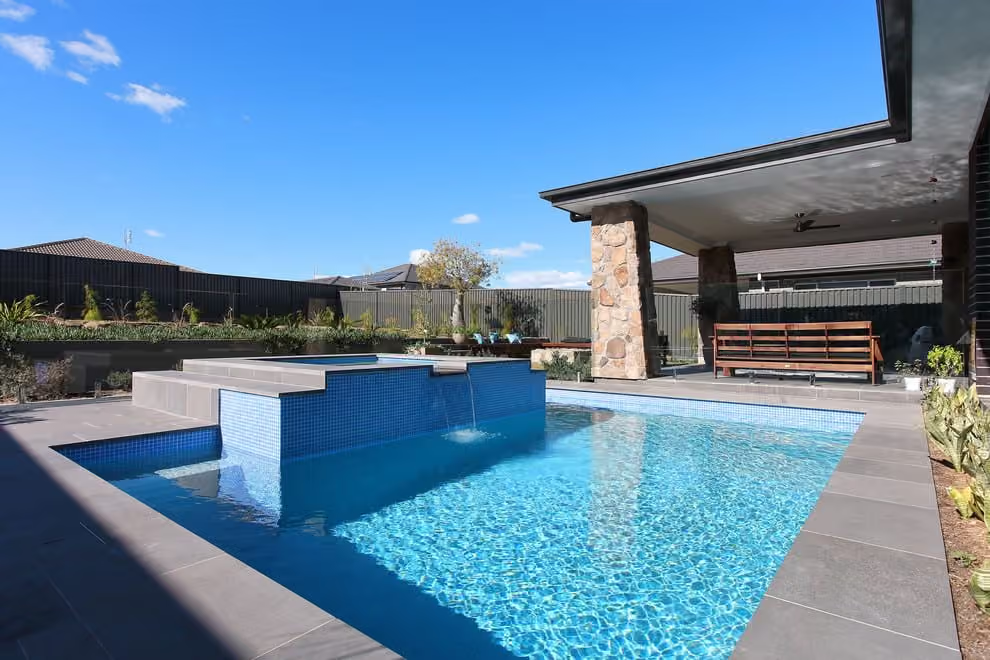
2. Integrated spa (spillover design): A raised spa at one end of the pool that spills into the main pool via a natural stone weir. This creates visual drama, provides warm water for relaxation, and uses shared equipment to reduce costs versus a separate standalone spa.
3. Wet-edge (infinity) pools: Particularly popular on sloping blocks in suburbs like Moorebank, Holsworthy, and St Clair where the backyard drops away. The vanishing edge creates a dramatic visual effect. Additional cost over standard pool: $15,000–$30,000.
4. Natural stone surrounds: Sandstone pavers, granite coping, and travertine pool surrounds have replaced concrete and brick pavers as the standard for quality pool areas. Cost: $80–$200/sqm installed (vs $40–$80/sqm for concrete pavers).
5. Pool-side outdoor kitchens: Integrated BBQ, sink, underbench fridge, and stone benchtop adjacent to the pool — creating a complete outdoor entertaining zone. Many Western Sydney families use their outdoor kitchen more frequently than the indoor kitchen during warmer months.
6. Automated covers and blankets: Retractable pool covers reduce heating costs by 50–70%, minimise chemical consumption, improve safety, and keep the pool clean. Fully automated systems: $8,000–$20,000.
Buildana designs homes with pool integration from the earliest concept stage — ensuring your pool area, outdoor living, and interior spaces flow naturally. Whether you're adding a plunge pool to a duplex courtyard or building a resort-style pool in your Fairfield custom home, we make it happen. Call 0476 300 300.
Pool Fencing Regulations in NSW (2026)
Pool fencing compliance is non-negotiable in NSW and is the most common source of council defect notices for residential properties. Under the Swimming Pools Act 1992 (as amended):
Mandatory requirements: • All swimming pools capable of holding 300mm or more of water must have a complying safety barrier • The barrier must be a minimum of 1200mm high (measured from the finished ground level on the outside of the barrier) • Gates must be self-closing and self-latching, with the latch positioned at least 1500mm from the ground (or shielded from children) • No climbable objects within 900mm of the inside of the fence (this includes garden beds, pot plants, retaining walls, outdoor furniture, and spa equipment) • No gaps greater than 100mm in the barrier that a child could pass through • The barrier must separate the pool from all other areas of the property — including the house (unless every door and window opening to the pool area has a compliant self-closing device)
Fencing material options and costs: • Aluminium tubular (powder-coated): $80–$150 per metre, compliant, durable, economical • Glass pool fencing (frameless): $350–$600 per metre, premium appearance, requires regular cleaning • Glass pool fencing (semi-frameless): $200–$400 per metre, good balance of aesthetics and cost • Combination: glass on visible sides, aluminium on boundary sides — $150–$350 per metre average
Registration and inspection: All pools in NSW must be registered on the NSW Swimming Pool Register. Councils can inspect at any time and issue directions to comply. Non-compliance penalties apply — up to $5,500 for individuals.
Before renting or selling a property with a pool, you must obtain a valid compliance certificate from council or an accredited certifier. These certificates are valid for three years.
Buildana integrates pool fencing into the overall landscape and design scheme — ensuring full compliance while maintaining the aesthetic flow of your outdoor space. Every pool we deliver includes full fencing certification as part of the handover package.
Buildana builds across Sydney. Visit /advisory/value-engineering to learn more or /contact to discuss your project.