

Insights · Renovations · Big decisions
Renovate or Sell? How to Decide in Sydney
Moving costs money you never see again. Renovating costs money that should end up in the walls.
The house doesn't work any more. Not enough bedrooms, a kitchen from another decade, nowhere to work. So the question lands: fix this one or find another? As a builder I've got an obvious bias, so I'll show you the sums and let them argue.
Short answer
Is it better to renovate or sell and buy in Sydney?
Renovate if you like the location, the structure is in decent shape, and the work won't push the value past what the best homes nearby fetch. Sell if the location no longer suits or the house can't be made to work. Moving brings transfer duty, agent fees and moving costs you don't get back; renovating puts money into your own home but brings disruption.
Written and reviewed by Oliver Alameri
Licensed builder, NSW Contractor Licence 487805C · Founder, Buildana
Fact-checked
Count the money that disappears when you move
Selling one house and buying another isn't a swap. On the purchase, NSW transfer duty alone is typically tens of thousands of dollars on a Sydney home; Revenue NSW has a calculator that will give you the exact figure for your price.
On the sale, there's agent commission and marketing. Then conveyancing on both sides, building and pest inspections, loan costs, removalists, and all the small things a new house needs. Add it up honestly. For many Sydney families it's a six-figure sum that buys nothing.
That money is the benchmark. If a renovation that fixes your house costs less than moving, and adds value, renovating is starting with an advantage.
- Transfer duty on the new purchase
- Agent commission and marketing on the sale
- Legal, inspection and loan costs, both sides
- Removalists and setting up the new place
Then price the renovation properly
Rawlinsons gives a good sense of scale. In Sydney it prices a mid-range kitchen fit-out at $19,500 to $22,000, and each bathroom at $23,500 to $26,500. Extending on the ground floor in brick veneer, 75 to 125 square metres, ran $1,835 to $1,980 a square metre in its 2021 edition, wet areas excluded, and prices have climbed since.
Add design, approvals, structural work you'll uncover, and possibly rent if you need to move out during the worst of it. An old house almost always reveals something once the walls are open: wiring, plumbing, asbestos, termite damage.
Get a realistic range, not the best case, before you compare it with moving.
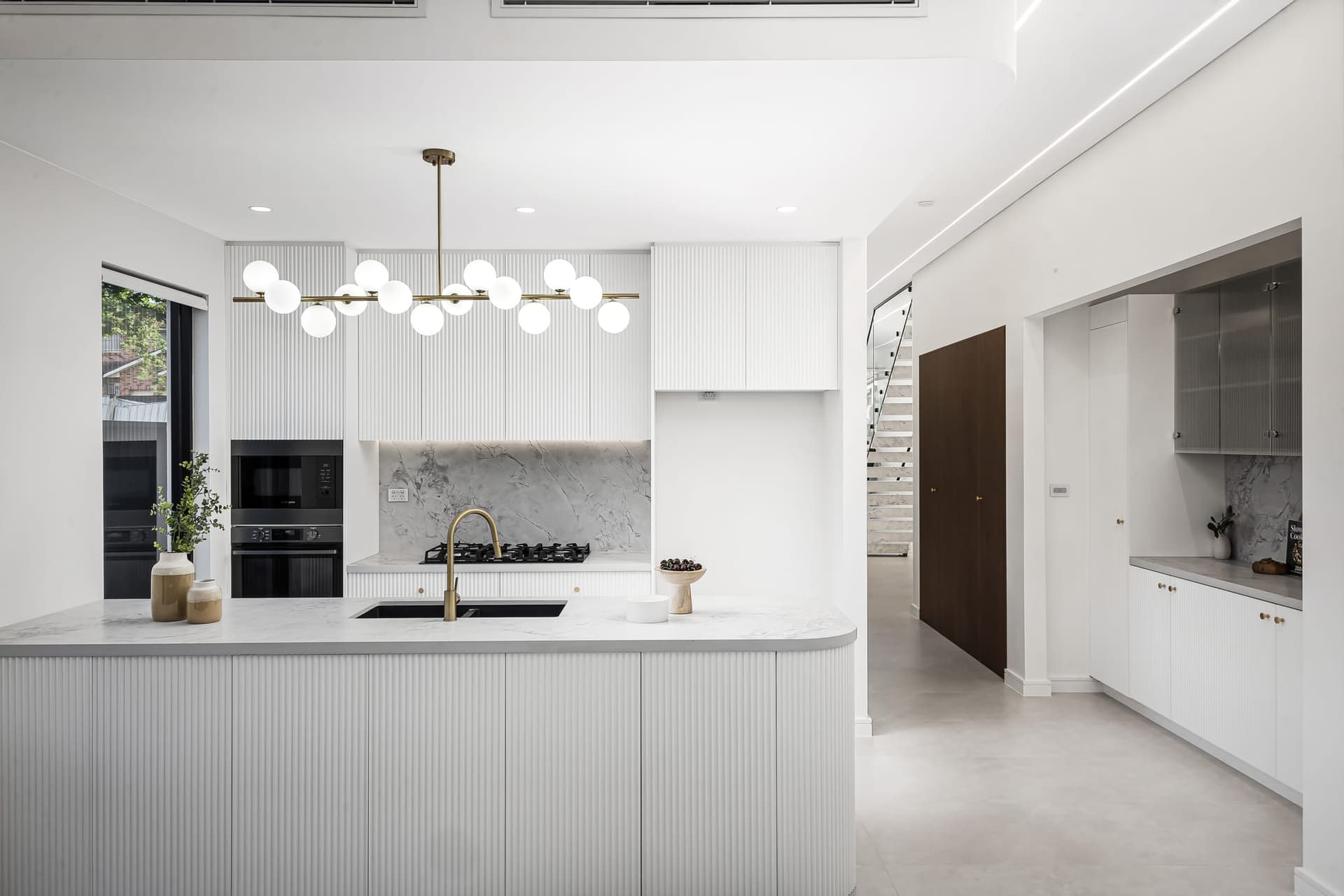
Weighing up a renovation against a move?
Tell me the three things your house needs to do. I'll price what it takes, so you can put a real renovation number next to the cost of moving.
0476 300 300The ceiling price of your street
Every street has a price ceiling: roughly what the best homes in it sell for. Renovate past it and you won't get the money back when you sell.
Pull the recent sales of fully renovated homes near you. If your house is worth $1.2 million now, renovated homes sell for $1.5 million, and the renovation costs $200,000, you're adding value. If renovated homes top out at $1.3 million and the work costs $250,000, you're spending for your own enjoyment, which is fine, as long as you know it.
Over-capitalising isn't always wrong. If you'll stay twenty years, the numbers matter less than the life you live in the house. Just go in with open eyes.
Renovate for the street you're in, unless you're staying so long the street doesn't matter.
What money can't fix
Location. If the commute is killing you, the school zone is wrong, or you need to be near family across town, no renovation solves it.
The lot itself. A south-facing backyard, a steep block, a busy road, or no room to extend can limit what any renovation achieves.
And your appetite for disruption. Months of trades, dust and decisions, possibly living in half a house. Some families handle it well. Some don't. Be honest about which one you are.
A quick way to decide
Write down the three things the house must do that it doesn't now. Ask a builder what it costs to make it do them. Ask an agent what the house would be worth afterwards, and what it's worth today. Add up what moving would cost.
If the renovation costs less than moving, keeps you under the street's ceiling and fixes the three problems, renovate. If it can't fix them, or the location is the problem, sell. And if the gap is huge, look at a knockdown rebuild on the same lot, which keeps the location and gives you a new house.
Before you list or renovate
Get these numbers first.
- 01
Total cost of moving, including transfer duty
- 02
Renovation priced as a realistic range
- 03
Current value and renovated value from a local agent
- 04
Recent sales that show your street's ceiling
- 05
Whether you'd need to rent during the work
- 06
The number of years you expect to stay
Renovate or sell questions
How much does it cost to move house in Sydney?
It varies with prices, but transfer duty on the new home, agent fees on the sale, legal and inspection costs, loan costs and removalists often add up to a six-figure sum for Sydney families.
What is over-capitalising?
Spending more on a renovation than it adds to the property's value, usually by pushing past the top of your street's recent sales. It's only a problem if you plan to sell soon.
Which is cheaper: extending, or buying something bigger?
Often extending is cheaper once moving costs are counted, especially if you like the location. It depends on the scale of the extension, the condition of the house and local prices.
Should I consider a knockdown rebuild instead?
If you love the location but the house needs so much work that renovating approaches the cost of new, a knockdown rebuild keeps the address and gives you a house designed from scratch.
Sources and references
Costs are from the Rawlinsons handbook with the local cost index applied; rules and timeframes are checked against the sources below.
Stay where you love. Fix what you don't.
A renovation priced honestly, so you can compare it with the cost of moving before you decide.