
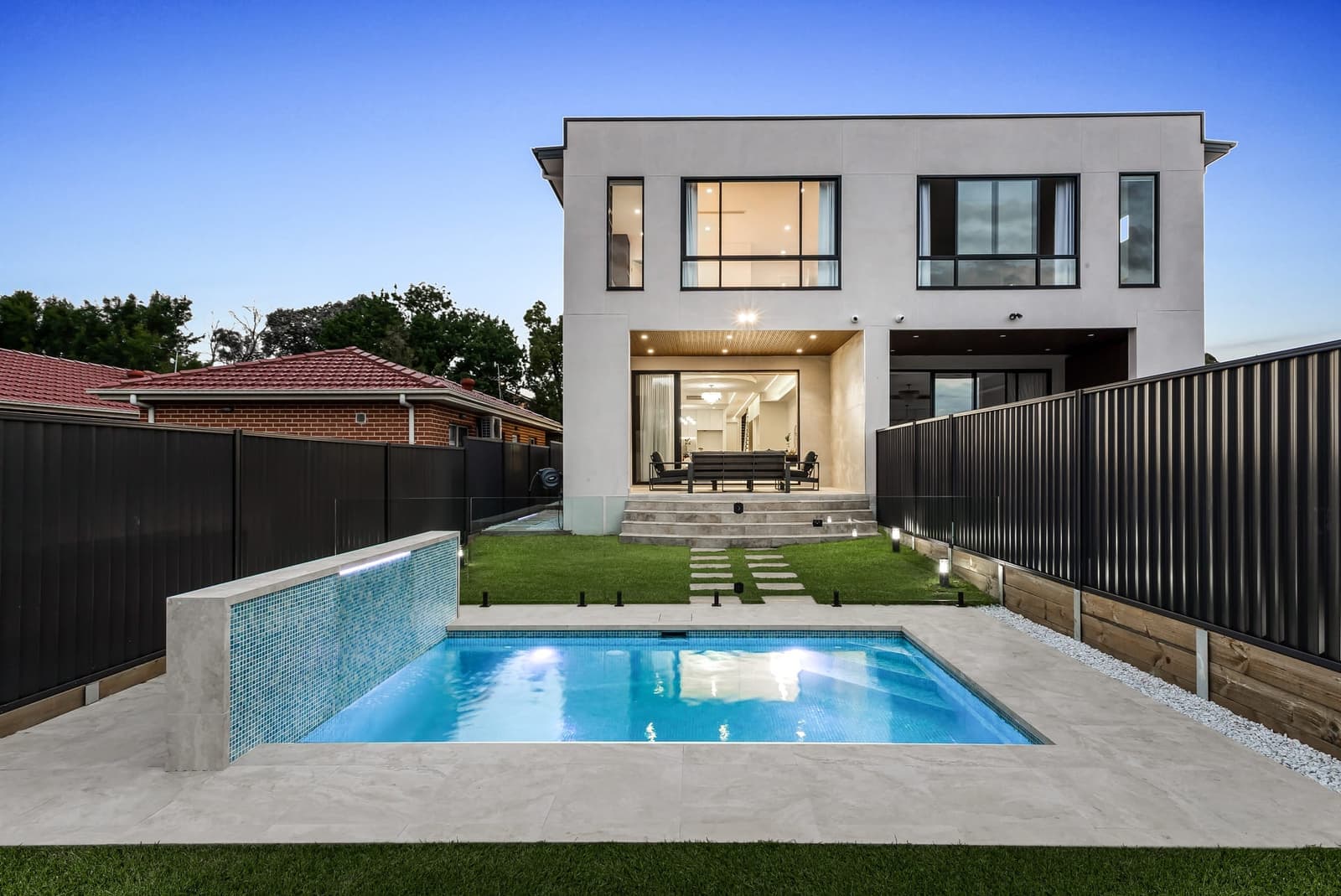
Wahroonga Home Builder — Custom Homes, KDR, Duplex
Licensed NSW builder (HBL 487805C) · Fixed-price contracts · Ku-ring-gai DA + CDC managed in-house
Wahroonga is premium upper north shore — Knox Grammar, Sydney Adventist Hospital (the San), and Wahroonga Park frame the suburb. Blocks 800–1,500m², heritage Federation streetscapes east of the Pacific Highway, and one of the strongest school catchments in Sydney. The hospital precinct adds zoning complexity on the western edge. Wahroonga station puts the city around 32 minutes away. The northern boundary runs into Hornsby Shire at Waitara.
What makes a Wahroonga build different from a generic Sydney build comes down to the Class M soil profile, the 1920s–1960s (heavy heritage stock) stock you're working around or removing, and the way Ku-ring-gai Council interprets DCP controls in this part of the LGA.
Council
Ku-ring-gai
Median price
$3.0M–$4.6M
Build cost (mid-spec)
$2,904–$3,498/m²
Typical lot
800–1,500m²
Soil class
M
DA timing
13–17 wks
Builder perspective
Building in Wahroonga — what we actually look at first
Wahroonga is bought for Knox and the San and kept for the trees. The Federation streets east of the Pacific Highway are Heritage Conservation Area, the blocks are 800 to 1,500m², and Ku-ring-gai runs the most aggressive canopy protection in New South Wales. Which means a builder in Wahroonga is negotiating with an arborist before a heritage officer before a certifier. The median sits at $3.0M to $4.6M and the station puts the city at about 32 minutes, so demand is not the risk here. The approval path is.
Plan on 13 to 17 weeks for a DA and 20-plus if you are in an HCA or want a significant tree removed, which most people do. The dual-occupancy minimum is 1,200m², so a fair share of these lots clear it on paper, but the heritage and tree overlays decide whether a duplex actually fits. Class M soil keeps footings honest. Around the hospital precinct on the western edge the zoning gets more complicated and worth checking early. The rebuilds that go smoothly here are the ones designed around the retained trees from day one rather than the ones that fight for removals. We survey the canopy before the boundaries.
Oliver Alameri — Founder & licensed builder
HBL 487805C · Reading Wahroonga sites since day one
Wahroonga build context
The data we use to feasibility-check a Wahroonga lot before quoting.
Council
Ku-ring-gai
Postcode
2076
Primary zoning
R2 Low Density
Typical lot size
800–1,500m²
Predominant home era
1920s–1960s
Soil class (AS 2870)
Class M
Duplex minimum lot
1,200m²
Median price band
$3.0M–$4.6M
Granny flat rental
$650–$850/week
Train station
Wahroonga
Build cost (mid-spec)
$2,904–$3,498/m² · Rawlinsons 2026
Why owners build with Buildana in Wahroonga
Same six facts on every contract — we just write them down so you can hold us to them.
- Holding NSW HBL 487805C with current statutory insurance — the contract you sign is the price you pay at handover.
- Ku-ring-gai approval-as-a-service — we lodge CDC or DA, manage council referrals and own every Request for Information that comes back.
- Engineering certificates, BASIX, surveying, geotech reports — sequenced and tracked by our project manager, never your problem.
- Pre-1990 fibro demolition handled by Class B asbestos contractors with proper containment — full clearance before any structural work begins.
- Fixed-price contract from demolition through to handover — Rawlinsons-aligned costing, no surprise variations.
- Anchored on the amanah principle — the scope on contract day is the scope at handover. Local landmark: Knox Grammar & Sydney Adventist Hospital (San). Train: Wahroonga.
Wahroonga build economics
Indicative cost ranges for a Buildana build in Wahroonga, benchmarked against the Rawlinsons Australian Construction Handbook 2026 Sydney baseline and adjusted for the local cost profile (Wahroonga sits above the Sydney median by 32%). Every figure is a starting point — a real feasibility shifts it by site condition, brief and finish spec.
| Build type | Indicative range | Spec assumptions |
|---|---|---|
| Single-storey custom home (200m² GFA, mid-spec) | $2,904–$3,498/m² × 200m² | Brick veneer, ColorBond roof, mid-tier joinery and finishes — Rawlinsons 2026 Sydney medium-spec baseline. |
| Double-storey custom home (300m² GFA, mid-spec) | $3,300–$4,092/m² × 300m² | Two-storey brick veneer, light-frame upper, ColorBond or tile, mid-spec finishes — first-floor adds engineering and access loadings. |
| Premium custom home (350m²+, full-brick or rendered) | $4,224–$6,336/m² × 350m²+ | Full-brick or rendered structure, hardwood or stone external, custom joinery throughout — Rawlinsons high-spec baseline. |
| Detached duplex (combined 350m² GFA) | $3,432–$4,356/m² combined | Twin-slab on separate footings or party-wall slab; independent services; BCA Vol 2 acoustic separation. |
| Knockdown rebuild (200m², mid-spec, includes demo) | $3,036–$3,762/m² × 200m² + $33K–$59K demo | Demolition (incl. SafeWork-licensed asbestos clearance), geotech, slab, frame, full mid-spec finish. |
| Granny flat (60m², Class 1a) | $240,000–$350,000 turnkey | Class 1a secondary dwelling, full kitchen + bathroom, BASIX-compliant, SEPP-pathway CDC where lot qualifies. |
Source: Rawlinsons Australian Construction Handbook 2026 (Sydney section), adjusted for Wahroonga cost profile via Buildana's internal suburb cost-adjustment matrix. Figures exclude land, professional fees, council contributions and FF&E.
Free Wahroonga feasibility
Thinking about building in Wahroonga? Start with the numbers, not a sales pitch.
Send us your address and rough brief. We'll come back with a straight read on your block — zoning, soil class, frontage, approval path and a real cost range against Rawlinsons 2026. No obligation, no pressure, just the facts you need before you spend a dollar on design.
Buildana services in Wahroonga
All six core services delivered across the Ku-ring-gai — each one priced against Wahroonga's specific site context, not a generic Sydney baseline.
Knockdown Rebuild
Knockdown rebuild as a single contract — demolition, geotech-driven slab, frame, fit-out and handover under one HBL licence.
Wahroonga knockdown rebuild approachDuplex
Duplex builds priced for both halves at once — bulk procurement savings on roof, frame and finishes flow through to a sharper square-metre rate.
Wahroonga duplex approachGranny Flat
Granny flats built as proper homes, not sheds — Class 1a construction, full BASIX, statutory warranty.
Wahroonga granny flat approachCustom Home
Custom homes that read as architecturally specific to the site — not the same façade you've seen three streets over.
Wahroonga custom home approachExtension
Rear and second-storey additions on established housing stock — structural integration and roof tie-ins costed honestly upfront.
Wahroonga extension approachRenovation
Whole-home reno or single-room — itemised scope, fixed price, no creep variations once we start.
Wahroonga renovation approachApproval pathway in Wahroonga
Ku-ring-gai Council, the upper north shore garden-suburb authority with NSW's most aggressive tree-canopy retention.
For a typical Wahroonga rebuild, the pathway decision happens before drafting starts. CDC through a private certifier — 15–25 working days for code-compliant rebuilds outside hcas — is the default for code-compliant single-storey work on R2 Low Density. DA through Ku-ring-gai Council — 13–17 weeks for a single-dwelling da, frequently 20+ weeks for hcas or significant-tree removals, $2,300–$3,800 base for a class 1a residential da in lodgement fees — is the path when the design needs to flex outside the Codes SEPP. The pathway shapes both timeline and design freedom, and we explain the trade-off in plain English before the contract.
CDC pathway
Private certifier · 15–25 working days for code-compliant rebuilds outside HCAs · no neighbour notification. Design must comply exactly with the Codes SEPP.
DA pathway
Ku-ring-gai merit assessment · 13–17 weeks for a single-dwelling DA, frequently 20+ weeks for HCAs or significant-tree removals · DA fees $2,300–$3,800 base for a Class 1a residential DA. Used where the design pushes a code limit.
Section 7.11 / 7.12 developer contributions in Wahroonga: Typically $10K–$25K per dwelling.
Wahroonga site considerations
Two unknowns swing the budget on a Wahroonga build. The first is geotechnical — Class M ground drives different footing systems, and getting that wrong shows up as cracking 18 months in. We commission the geotech upfront and engineer to the report, not to a generic Sydney slab. The second is what's actually in the existing 1920s–1960s (heavy heritage stock) structure when demo opens it up — asbestos in old fibro, redundant lead-jointed copper plumbing, structural rot at wet-area perimeters. The contract assumes the worst-case asbestos scope so there's no mid-job variation.
Soil & footings
Class M reactivity drives waffle-pod, stiffened raft or piered slab — engineered to a real geotech, not a desktop guess.
Demolition
Pre-1990 1920s–1960s (heavy heritage stock) stock means SafeWork-licensed asbestos clearance — priced into the contract upfront, with the clearance certificate before slab pour.
Flood & bushfire
Flood risk: very low. Bushfire risk: significant. Heritage exposure: high. We map your lot against each before quoting.
Local overlays the Ku-ring-gai planner will check first
- Heritage Conservation Areas (Pymble, Killara, Wahroonga, Warrawee, Turramurra pockets)
- Tree preservation (canopy retention — the most aggressive in NSW)
- Bushfire prone land (Ku-ring-gai Chase + Lane Cove National Park interfaces)
- Foreshore Scenic Protection Area
Recent builds nearby
Buildana projects in the Ku-ring-gai
We work continuously across Ku-ring-gai — single-storey customs, double-storey rebuilds, side-by-side duplex on R2 lots that comply with Ku-ring-gai's DCP minimum frontage, granny flats on SEPP secondary-dwelling pathways. Most projects start with the same conversation we'd have about your Wahroonga site: title, zone, slope, frontage, soil. Then design. Then fixed-price contract.
Real project case studies
Read full Buildana builds — the challenge, the fixed-price solution, the real timeline and cost — across Western Sydney.
Read case studiesKu-ring-gai hub
Full Ku-ring-gai builder hub — every suburb we work in, every service, council pathway notes.
Open Ku-ring-gai hubFree Wahroonga site check
Send your Wahroonga address — we'll run title, zone, slope, frontage and soil before you spend a dollar.
Book a site checkWahroonga build FAQs
The questions we get asked most often on a first Wahroonga site walk.
- What does it cost to knock down and rebuild in Wahroonga?
- End values in Wahroonga sit in the $3.0M–$4.6M range based on recent sales. A typical knockdown rebuild — demo, asbestos clearance, geotech, slab, frame, full mid-spec finish for a 200m² single-storey — runs $3,036–$3,762/m² × 200m² + $33k–$59k demo as a Rawlinsons-aligned 2026 baseline. We benchmark every line to the Rawlinsons Australian Construction Handbook, not back-of-envelope figures. Send through your block address and we'll run a proper feasibility against what's actually achievable on the lot.
- Do you do extensions and renovations in Wahroonga?
- Yes — ground-floor additions, second-storey adds, full-house renovations, kitchens and bathrooms in Wahroonga. The complication on 1920s–1960s (heavy heritage stock) housing stock is that you can't price an extension off the plans alone — we pre-investigate the existing slab, frame, roof tie-in and wet-area waterproofing before quoting. Surprises during demolition are the most common reason renos blow their budget; we eliminate that by inspecting first.
- How long does a DA take with Ku-ring-gai Council?
- 13–17 weeks for a single-dwelling DA, frequently 20+ weeks for HCAs or significant-tree removals. CDC through a private certifier is the alternative where the design complies with the Codes SEPP — 15–25 working days for code-compliant rebuilds outside hcas. Council DA application fees fall in the $2,300–$3,800 base for a class 1a residential da range. Buildana lodges either pathway and runs all RFI responses through to determination.
- Why does Wahroonga cost different from a generic Sydney average?
- Wahroonga sits 32% above the Sydney metropolitan median build cost. Drivers are typically site access (narrow streets, restricted parking), tighter character controls requiring better materials and finishes, and trades pricing the suburb's expectation of finish quality.
- How long does a custom home build take in Wahroonga?
- From contract signed to handover, a single-storey 4-bedroom custom home in Wahroonga typically takes 9–11 months on a CDC pathway, or 12–14 months if the design needs a DA through Ku-ring-gai Council. Add 4–6 weeks for double-storey. Pre-construction (design, engineering, BASIX, approval, contract) runs in parallel and adds another 8–16 weeks before site start. Buildana sequences both phases so the design effort and the approval effort don't sit waiting on each other.
- Can I build a duplex in Wahroonga?
- Duplex feasibility in Wahroonga depends on lot size and zoning. The minimum lot for dual occupancy under Ku-ring-gai Council's DCP is 1,200m² on R2 Low Density — side-by-side detached duplex is the most common configuration on compliant blocks. We run a feasibility check on title, zone, area, frontage and slope before quoting — no point designing what won't approve.
- What's the granny flat pathway in Wahroonga?
- Secondary dwellings in Wahroonga are governed by State Environmental Planning Policy (Housing) 2021 and applicable planning controls. CDC is available only where the lot and design satisfy the complying-development standards, including lot area, floor area, setbacks and exclusions. Smaller or constrained lots may require a DA; zoning alone does not establish eligibility. We check the title, overlays and current controls with the certifier or Ku-ring-gai Council before design.
- What soil class is typical in Wahroonga 2076?
- Wahroonga ground is typically Class M based on the AS 2870 site classifications and geotech we've worked with in the suburb. That drives slab design — waffle-pod, stiffened raft or a piered system depending on the report. We never assume it; every Buildana build commissions a geotechnical investigation before slab engineering. The geotech report is yours to keep, regardless of which builder you use after.
Nearby Ku-ring-gai suburbs we build in
Adjacent Ku-ring-gai suburbs covered by the same Ku-ring-gai approval pathway and a similar site-cost profile.
Ready to talk about your Wahroonga build?
Free site feasibility, honest cost framing against $2,904–$3,498/m² baseline, fixed-price contract. Ku-ring-gai pathway managed in-house — no surprise variations.