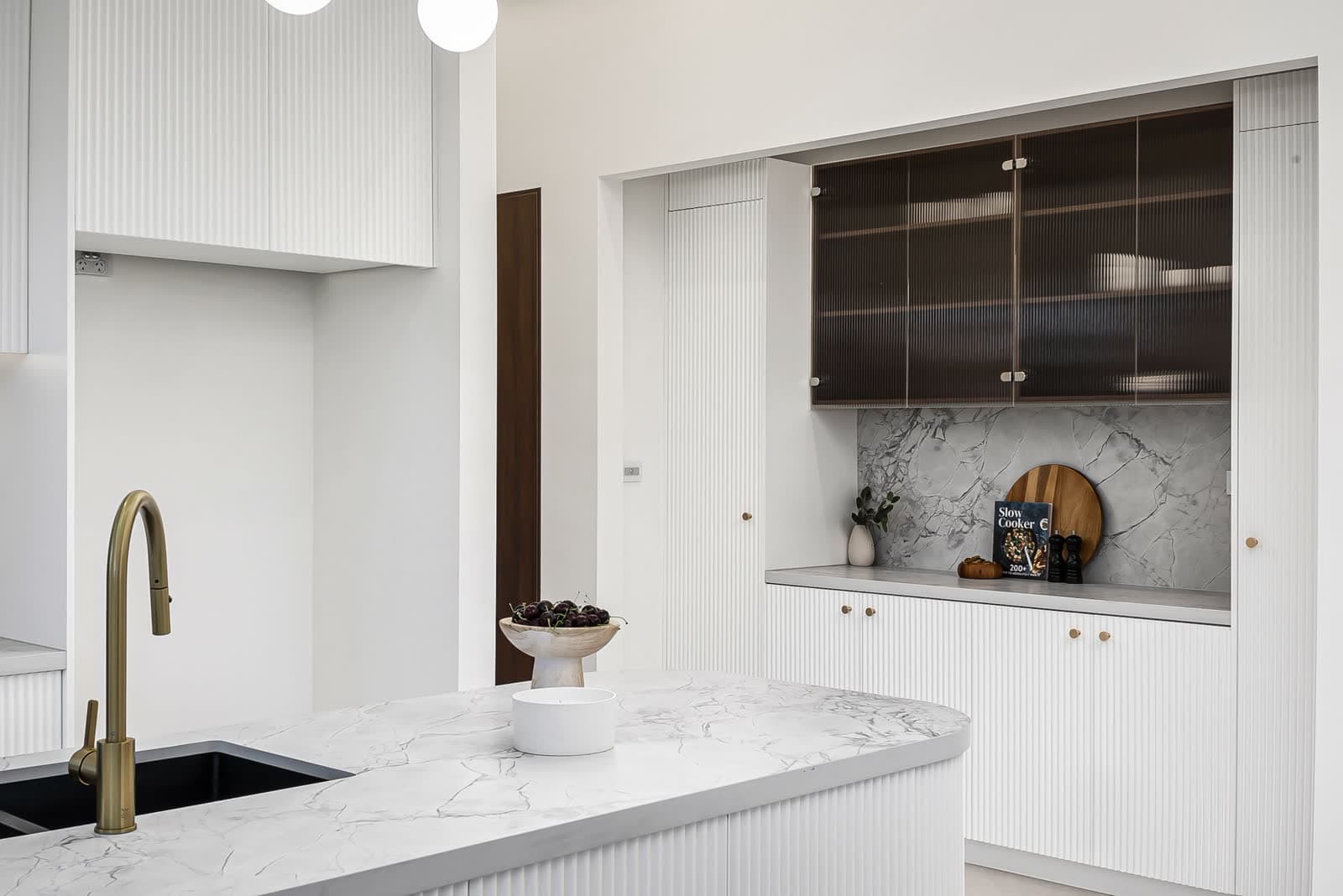
Granny Flat Builder Tempe — From $150K Fixed Price
Fixed-price granny flat construction in Tempe 2044. 1-bed from $150K, 2-bed from $185K. CDC approval, Inner West Council compliant. No hidden extras.

Quick Answer
A granny flat in Tempe costs $150,000–$300,000+ depending on size and finishes. 1-bed from $150K, 2-bed from $200K. CDC fast-track approval in 10–15 business days. Buildana manages design, Inner West Council approval and fixed-price construction.
Building Granny Flats in Tempe
Granny flat in Tempe works on 200–500m² lots. ANIP flight-path overlays affect specs. Wianamatta Shale with alluvial near the Cooks River. $500–$700/week. Realistic build cost $200K–$320K.
On the ground in Tempe (2044), the practical numbers shape every granny flat. Class M (Wianamatta Shale / Hawkesbury Sandstone interface) / H (Iron Cove + Parramatta River fall on Balmain peninsula) soil — moderately to highly reactive clay — pushes engineered foundation work into the $24,000–$42,000 bracket on most 200–500m² blocks. R1/R2 General/Low / R3 Medium (Marrickville-Sydenham + station precincts) / R4 (Bays West, Sydenham-to-Bankstown corridor) zoning under Inner West Council sets the building envelope, with R3 Medium Density pockets that open up dual occupancy options on qualifying lots. Median sale price across Tempe sits at $1.6M–$2.4M, which frames the build-versus-buy decision from the start. Tempe (T4/T8, in suburb) station services the suburb, and that proximity affects everything from rental demand to construction site access.
Buildana manages the full granny flat process in Tempe — from site assessment and CDC fast-track approval through to fixed-price construction and handover. We build studio, 1-bedroom, and 2-bedroom designs up to the NSW maximum of 60m².
Read our Complete Granny Flat Guide or explore granny flat builds across Sydney.
- Granny flats in Tempe from $150K
- CDC fast-track approval (10–15 business days)
- 200–500m² blocks — most qualify for 60m² granny flat
- Tempe zoned R1/R2 General/Low / R3 Medium (Marrickville-Sydenham + station precincts) / R4 (Bays West, Sydenham-to-Bankstown corridor)
- Fixed-price contract — design to handover
- Class M (Wianamatta Shale / Hawkesbury Sandstone interface) / H (Iron Cove + Parramatta River fall on Balmain peninsula) soil — engineered slab included
- Rental yield $500–$750/week (limited — most lots too small) in Tempe
- Free site assessment — near Tempe (T4/T8, in suburb) station
Reviewed by Oliver Alameri
Licensed Builder (NSW 487805C) · Master of Property Development · PhD Student · Building across Western Sydney since 2010
Why Build a Granny Flat in Tempe?
Tempe is the small inner west suburb between St Peters and the Cooks River — Victorian terraces, Federation cottages, inter-war heritage and post-war on 200–500m² blocks. Heritage Conservation Areas in pockets. Wianamatta Shale soil with alluvial pockets near the Cooks River. WestConnex/M8 corridor and Princes Highway define the western edge. IKEA Tempe and the airport flight path proximity.
Tempe's mix of 1900s–1950s-era housing on 200–500m² blocks creates strong opportunity for property improvement. Median prices of $1.6M–$2.4M support quality build investment. Tempe benefits from Tempe (T4/T8, in suburb) station on the doorstep — walkable rail access lifts both rental demand and property values. Secondary dwellings on 200–500m² blocks deliver rental returns of $500–$750/week (limited — most lots too small) per week. CDC approval through a private certifier typically takes 10–15 business days. Soil conditions in Tempe (Class M (Wianamatta Shale / Hawkesbury Sandstone interface) / H (Iron Cove + Parramatta River fall on Balmain peninsula), moderately to highly reactive) are factored into every Buildana foundation design.
Granny flats in the Inner West are largely impractical — most lots are 100–350m² Victorian terraces wall-to-wall HCA, leaving no compliant siting envelope. The viable granny flat sites are the larger inland blocks (350m²+) in Ashbury, Croydon Park, Croydon, Summer Hill, parts of Ashfield, Lewisham, Dulwich Hill, Marrickville, Tempe, St Peters, Stanmore. Where viable, granny flats deliver $500–$750/week. Heritage Conservation Areas restrict siting on Federation/Victorian streetscapes. Tree Preservation Order LGA-wide — AS4970 root-zone protection plans routine on protected canopy trees. Industrial-legacy contamination clearance required on Marrickville/Sydenham/St Peters parcels. Aircraft Noise Insulation overlays affect siting/glazing specs on parts of Tempe, Sydenham, St Peters. Most lots end as no-go on physical compliance alone — full feasibility before contract is non-negotiable.
Planning Controls — Inner West Council
Inner West LEP 2022 (consolidating the legacy Ashfield, Leichhardt and Marrickville LEPs) & Inner West DCP. R1 General Residential / R2 Low Density covers most older streets: FSR 0.5–0.6:1, building height 8.5–9m, front setback 3–6m, landscaped area 30–40%. R3 Medium Density along the Sydenham-to-Bankstown Metro corridor, station precincts (Marrickville, Dulwich Hill, Lewisham, Petersham, Stanmore, Newtown, Ashfield, Summer Hill) and major roads permits FSR up to 0.95:1. R4 High Density and B4 Mixed Use concentrated on Bays West masterplan precinct (Rozelle, Lilyfield), Sydenham-to-Bankstown corridor (Marrickville, Dulwich Hill, Sydenham), Ashfield town centre, Newtown/King Street, and station-precinct overlays under the 2024 NSW TOD reforms. Heritage Conservation Areas are amongst Sydney's heaviest — virtually entire suburbs are HCA in Annandale, Balmain, Balmain East, Birchgrove, Camperdown, Croydon, Enmore, Haberfield (the Federation Garden Suburb HCA covers nearly the whole suburb), Leichhardt, Newtown, Petersham, Rozelle, Stanmore, with substantial HCA coverage in Ashfield, Dulwich Hill, Lewisham, Lilyfield, Marrickville, St Peters, Summer Hill. Tree Preservation Order LGA-wide. Wall-to-wall Victorian terrace and Federation cottage stock means duplex feasibility is largely impractical and KDR is precluded across vast portions of the LGA — extension and heritage-grade restoration dominate. Hawkesbury Sandstone soil dominant on the Balmain peninsula (Balmain, Balmain East, Birchgrove, Rozelle, Lilyfield) with substantial fall to Iron Cove and the harbour — suspended slab engineering, structural underpinning, sandstone rock excavation $20K–$60K standard, Foreshore Building Line restrictions on harbour-frontage. Wianamatta Shale soil predominant on the southern and inland portions. Industrial-legacy contamination management protocols apply to remediated parcels in Marrickville, Sydenham, St Peters and parts of Tempe (former brick pits, brewery, light industry). The Sydenham-to-Bankstown Metro upgrade (Sydney Metro City & Southwest) and Bays West masterplan precinct are the LGA's two signature redevelopment events. WestConnex/M8 corridor through St Peters, Tempe and the Sydenham junction defines the southern transport spine. Aircraft Noise Insulation Project (ANIP) overlays affect parts of Tempe, Sydenham, St Peters, Marrickville on the Sydney Airport flight path.
Granny flat builder in Tempe — key facts
- Suburb
- Tempe, NSW 2044
- Council / LGA
- Inner West Council (Inner West)
- Primary zoning
- R1/R2 General/Low / R3 Medium (Marrickville-Sydenham + station precincts) / R4 (Bays West, Sydenham-to-Bankstown corridor)
- Typical lot size
- 200–500m²
- Soil class
- Class M (Wianamatta Shale / Hawkesbury Sandstone interface) / H (Iron Cove + Parramatta River fall on Balmain peninsula)
- Median house price
- $1.6M–$2.4M
- Home era
- 1900s–1950s
- Typical price range
- $150,000 – $300,000+
- Typical timeline
- 4–6 months design to handover
- Approval pathway
- CDC via NSW Affordable Rental Housing SEPP (10–15 days)
Building in Tempe — Local Context
Site & Ground Conditions in Tempe
Tempe sits on Class M (Wianamatta Shale / Hawkesbury Sandstone interface) / H (Iron Cove + Parramatta River fall on Balmain peninsula) soil — moderately to highly reactive clay. For a granny flat, that rules out the cheapest off-the-shelf slab designs straight away. and pushes engineered footings into the $24,000–$42,000 range on most 200–500m² blocks here. Geotechnical testing isn't optional — every Buildana secondary dwelling in Tempe starts with a borehole report so the slab and footings are sized to your actual block, not a generic spec. Skipping that step is how you end up with cracked cornices and sticking doors three years in. Drainage design matters too — overland flow paths on Tempe's topography can collect water against rear setbacks if the contour survey is sloppy.
What Inner West Council Wants to See
Approval in Tempe comes down to documentation quality. Inner West Council processes a high volume of residential applications, and the ones that get approved fast share three traits: clean drawings that show every required setback dimension on plan; a BASIX certificate that matches the actual specification (not a stand-in); and an engineering package sized correctly for the Class M (Wianamatta Shale / Hawkesbury Sandstone interface) / H (Iron Cove + Parramatta River fall on Balmain peninsula) ground. For CDC, you also need to demonstrate compliance with every clause of the State Environmental Planning Policy (Exempt and Complying Development Codes) 2008. We prepare every document at full lodgement standard the first time.
Where the Money Goes on a Tempe Secondary dwelling
Cost breakdown for a typical secondary dwelling in Tempe: structure and frame around 30%, slab and foundations 8–14% (driven by Class M (Wianamatta Shale / Hawkesbury Sandstone interface) / H (Iron Cove + Parramatta River fall on Balmain peninsula) soil), roofing and external 10–12%, services (plumbing, electrical, HVAC) 12–18%, fit-out (kitchen, bathrooms, joinery) 18–25%, and finishes (paint, tiles, flooring) 8–12%. The remaining 4–6% covers approvals, certifications, and site establishment. Buildana itemises every line so you see what you're paying for — no lump sums hiding margin.
What Makes a Secondary dwelling Work in Tempe
Tempe (2044) is part of Inner West. Tempe (T4/T8, in suburb) station is the rail anchor for the suburb. Building well here means understanding what the suburb actually rewards — and what it punishes. Reward: thoughtful orientation, family-scale outdoor entertaining, durable materials that look right against the 1900s–1950s streetscape, and floor plans that handle multi-generational living without feeling cramped. Punish: over-glazing on west elevations (summer heat is brutal), thin slab specs on Class M (Wianamatta Shale / Hawkesbury Sandstone interface) / H (Iron Cove + Parramatta River fall on Balmain peninsula) ground, generic project-home elevations that ignore the street rhythm. Buildana has built across Inner West long enough to know where the line sits.
Why Some Tempe Builds Stall
Builds in Tempe stall for predictable reasons. Lodgement defects (missing BASIX, wrong drawing scale, undeclared overlays). Soil surprises on Class M (Wianamatta Shale / Hawkesbury Sandstone interface) / H (Iron Cove + Parramatta River fall on Balmain peninsula) ground when the builder didn't commission a borehole upfront. Variation creep when the contract was light on inclusions. Trade scheduling gaps when the builder is over-committed across too many sites. Inner West Council delays when neighbour objection triggers committee review. Buildana protects against each of these at contract stage — fully documented lodgement pack, geotech in the price, itemised inclusions instead of allowances, and a tight project-manager-to-job ratio that keeps trades moving.
Builder's Take on Tempe
Rental yield on a Tempe granny flat typically sits around 8–11% gross — often stronger than the main dwelling in percentage terms. The $200K–$260K build returns $18K–$28K per year in gross rent. Even after expenses, it clears comfortably.
Detached vs attached in Tempe: if your block is deeper than 30m, detached almost always wins. Separate entry, independent outdoor space, cleaner rental listing. Attached only makes sense when the block is too narrow to get a detached past the 900mm setback.
Tempe vs Nearby Suburbs
Tempe vs nearby suburbs — key metrics for building a granny flat.
| Suburb | Median Price | Typical Lot | Soil Class | GF Rental | Station |
|---|---|---|---|---|---|
| Tempe2044this suburb | $1.6M–$2.4M | 200–500m² | Class M (Wianamatta Shale / Hawkesbury Sandstone interface) / H (Iron Cove + Parramatta River fall on Balmain peninsula) | $500–$750/week (limited — most lots too small) | Tempe (T4/T8, in suburb) |
| St Peters2044 | $1.6M–$2.5M | 150–400m² | Class M (Wianamatta Shale / Hawkesbury Sandstone interface) / H (Iron Cove + Parramatta River fall on Balmain peninsula) | $500–$750/week (limited — most lots too small) | St Peters (T8, in suburb) |
| Sydenham2044 | $1.5M–$2.4M | 150–400m² | Class M (Wianamatta Shale / Hawkesbury Sandstone interface) / H (Iron Cove + Parramatta River fall on Balmain peninsula) | $500–$750/week (limited — most lots too small) | Sydenham Metro/T3 (in suburb) |
| Wolli Creek2205 | $700K–$1.4M (apartments) | N/A (apartment-led precinct) | Class M (Wianamatta Shale + Botany Sands) / Class P/E (alluvial near Cooks River + Botany Bay foreshore) | $480–$720/week (post-war stock supports siting) | Wolli Creek (T4/T8, in suburb) |
Median price, soil class, and lot size shape build feasibility and final cost. Buildana assesses every site against these and other constraints during the free feasibility stage.
Have a question about your project?
Talk to our team — free site assessment and fixed-price quote.
How It Works
From First Call to Final Key
Assessment is the most important hour you'll spend on the project. Get the position, orientation, and access right and the build runs clean.
⏱We design your granny flat to maximise the 60m² allowance within Inner West Council's setback and POS requirements. Floor plan, elevations, and 3D render provided.
⏱CDC pathway exists specifically for compliant granny flats — use it. No neighbour notification, no Inner West Council planner queue, no committee politics.
⏱Fixed-price build: slab (Class M (Wianamatta Shale / Hawkesbury Sandstone interface) / H (Iron Cove + Parramatta River fall on Balmain peninsula) engineered), frame, roof, fit-out, connections. 10–16 weeks depending on size.
⏱Walk through your finished granny flat, collect keys. Occupation Certificate, 6-year structural warranty, and maintenance guide provided.
⏱Quality Promise
Buildana Tempe granny flats: designed for your block, built to CDC standards, delivered under a fixed-price contract.
Cost Guide
| Item | Estimated Range |
|---|---|
| Rental income model (Tempe 1-bed) | $170,000 – $220,000 |
| Family member (dependent living) | $190,000 – $250,000 |
| Teenager retreat / adult child | $160,000 – $210,000 |
| Home office / short-stay | $150,000 – $200,000 |
| Future main dwelling (build granny first, big house later) | $200,000 – $260,000 |
Prices are indicative for Western Sydney (2025). Actual costs depend on site, specifications, and approvals.
Our Team
Oliver Alameri
Founder / Director / Builder · MPropDev · PhD Student
Ahmad Alameri
Accounts Manager
Claire Wendell
Project Manager
Estimate Your Build Cost
Use our free calculator to get an instant cost estimate for your project
Ready to take the next step?
Free consultation — no obligation, no pressure.
Frequently Asked Questions
“Buildana built our granny flat in just 12 weeks. Fast approvals, great communication, and a beautiful final product. Highly recommend.”
Fatima Al-Rashid
Liverpool, NSW
We Build Across Sydney
Buildana builds across greater Sydney — with deep roots in Western Sydney's Fairfield, Liverpool, Cumberland, Canterbury-Bankstown, and Blacktown LGAs.
Last updated: 1 July 2025
Granny Flat on Your Tempe Block
Free site assessment for Tempe 2044. We'll check your block, recommend the best design, and provide a fixed-price quote.
Start Your Project