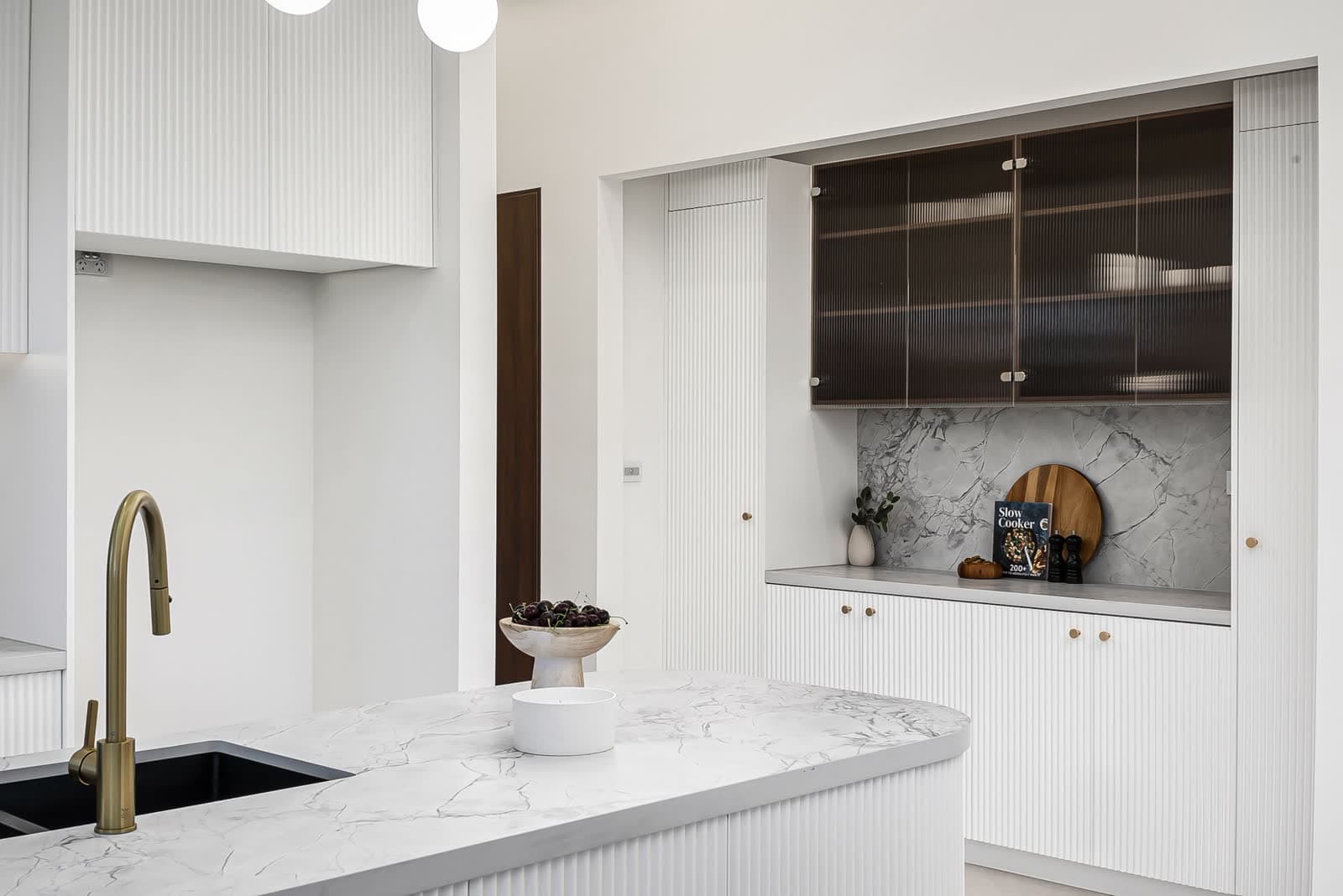
Knockdown Rebuild Meadowbank — Demo to Handover in 12 Months
Meadowbank 2114 KDR with tight programme: demolition (3–4 weeks), new home (24–40 weeks). CDC fast-track or City of Ryde Council DA. Weekly progress updates.

Meadowbank KDR — Single Contract, New Home
KDR in Meadowbank is rare — high-rise apartments dominate around the station precinct. Limited detached KDR-feasible stock inland on 400–700m² blocks. R4 station-precinct redirects strategic sites to apartment redevelopment. Wianamatta Shale soil. End values $1.6M–$2.4M for the limited detached market. Pre-construction 4–6 months.
For a rebuild in Meadowbank, the economics are the framing question. Median price $1.7M–$2.5M (apartments dominate); build cost on 400–700m² blocks scales by site conditions and specification. Class M (Wianamatta Shale) / H (Lane Cove + Parramatta River fall, sandstone outcrops) ground (moderately to highly reactive clay) keeps foundations honest — $24,000–$42,000 band — and blowouts on that line are the single most common reason fixed-price contracts elsewhere don't stay fixed. Buildana itemises the slab, structural engineering, and geotech work upfront so you see the actual cost in the contract. R3 zoning in pockets of Meadowbank opens up dual occupancy potential — worth exploring even if you're not initially considering it.
Buildana manages the complete knockdown rebuild process in Meadowbank — from site assessment and architectural design through to DA or CDC approval, demolition management, and fixed-price construction to handover. One builder, one contract, one new home.
Read our KDR Cost Guide 2026 or use the Renovation vs KDR Calculator to compare options.
- New home in Meadowbank from $450K
- City of Ryde Council DA and CDC approvals managed
- Demolition and asbestos removal included
- Class M (Wianamatta Shale) / H (Lane Cove + Parramatta River fall, sandstone outcrops) soil — engineered slab design included
- Typical blocks 400–700m² in Meadowbank
- Single and two-storey designs available
- 6-year structural warranty
- Free site assessment — near Meadowbank (T9, in suburb) station
Reviewed by Oliver Alameri
Licensed Builder (NSW 487805C) · Master of Property Development · PhD Student · Building across Western Sydney since 2010
Why Knockdown Rebuild in Meadowbank?
Meadowbank is the riverside rail-line suburb on the Parramatta River — high-rise apartments dominate around the station precinct, with Federation cottages and post-war detached inland on 400–700m² blocks. R4 station-precinct redevelopment intense. Wianamatta Shale soil. Meadowbank Wharf with ferry connection.
Building costs in Meadowbank sit well below the Sydney metro average, making it an attractive location for value-conscious homeowners and investors. 400–700m² blocks at median prices of $1.7M–$2.5M (apartments dominate) offer strong land-to-build ratios. Direct rail access from Meadowbank (T9, in suburb) station adds genuine value to Meadowbank property. 1900s–1970s + apartments 2000s+-era housing stock across Meadowbank is prime for knockdown rebuild — replacing dated layouts and materials with modern, NCC-compliant homes that maximise block potential. Class M (Wianamatta Shale) / H (Lane Cove + Parramatta River fall, sandstone outcrops) soil (moderately to highly reactive) is standard for Meadowbank — Buildana includes engineered slab design in every quote.
KDR in Ryde works Wianamatta Shale inland on R2 lots outside Heritage Conservation Areas — North Ryde, Marsfield, Denistone East, Denistone West, inland West Ryde, parts of Ryde, Eastwood pockets. Riverside heritage areas (Putney village, Tennyson Point, Gladesville Victoria Road precinct) are extension-restricted. Wianamatta Shale soil; rock excavation typically $5K–$20K shallow, deeper $15K–$40K on Lane Cove or Parramatta River fall lots with sandstone outcrops. Demolition $30K–$60K with asbestos prevalent in 50s–70s stock. Tree preservation strict — Council retention of canopy trees usually requires AS4970 root-zone protection plans on KDR. Riparian setbacks 10–40m from Lane Cove River (East Ryde, North Ryde) and Parramatta River (Meadowbank, Melrose Park, Putney). Realistic premium turnkey $1.3M–$2.4M for 280–450m² build inland; $2.0M–$3.8M on river-fall lots in Putney, Tennyson Point, Gladesville. Pre-construction 4–7 months inland; 6–9 months on river-fall and heritage-adjacent sites.
Planning Controls — City of Ryde Council
Ryde LEP 2014 & Ryde DCP 2014. R2 Low Density covers most residential streets: FSR 0.5–0.55:1, building height 9.5m, front setback 6–7.5m, landscaped area 40–50% (Ryde DCP enforces 50% on >580m² lots). R3 Medium Density along Victoria Road, Blaxland Road, Devlin Street and Lane Cove Road permits FSR up to 0.9:1. R4 High Density and B4 Mixed Use concentrated on Macquarie Park strategic centre, Top Ryde City precinct, Meadowbank station precinct, West Ryde station precinct and the Eastwood town centre. Duplex minimum lot 580m² (slightly below the typical 600m² standard). Heritage Conservation Areas in pockets — West Ryde Federation streets, Putney village core, Gladesville Victoria Road and side streets, Eastwood Brush Farm Park precinct, Denistone heritage streets. Tree Preservation Order LGA-wide and strict — Ryde retains substantial bushland (Lane Cove National Park frontage on East Ryde, North Ryde; Field of Mars Reserve in Ryde). Wianamatta Shale soil predominant; sandstone outcrops on the Lane Cove River fall (Putney, Tennyson Point, Gladesville) and Parramatta River fall (Meadowbank, Melrose Park) — suspended slab engineering on premium river-fall lots. Riparian setbacks apply to all Lane Cove River and Parramatta River frontages. Sydney Metro Macquarie Park / North Ryde stations and the Macquarie University Hospital + Macquarie University precinct anchor the LGA's strategic centre. Melrose Park master-planned brownfield redevelopment (PAYCE 25-hectare precinct) under specific design controls with industrial-legacy contamination management on remediated parcels.
Knockdown-rebuild builder in Meadowbank — key facts
- Suburb
- Meadowbank, NSW 2114
- Council / LGA
- City of Ryde Council (City of Ryde)
- Primary zoning
- R2 Low / R3 Medium / R4 (Macquarie Park, Top Ryde, Meadowbank station precincts)
- Typical lot size
- 400–700m²
- Soil class
- Class M (Wianamatta Shale) / H (Lane Cove + Parramatta River fall, sandstone outcrops)
- Median house price
- $1.7M–$2.5M (apartments dominate)
- Home era
- 1900s–1970s + apartments 2000s+
- Typical price range
- $450,000 – $1,200,000+
- Typical timeline
- 14–22 months including demolition
- Approval pathway
- CDC where eligible or DA for complex sites
Building in Meadowbank — Local Context
Site & Ground Conditions in Meadowbank
Meadowbank sits on Class M (Wianamatta Shale) / H (Lane Cove + Parramatta River fall, sandstone outcrops) soil — moderately to highly reactive clay. For a knockdown rebuild, that rules out the cheapest off-the-shelf slab designs straight away. and pushes engineered footings into the $24,000–$42,000 range on most 400–700m² blocks here. Geotechnical testing isn't optional — every Buildana rebuild in Meadowbank starts with a borehole report so the slab and footings are sized to your actual block, not a generic spec. Skipping that step is how you end up with cracked cornices and sticking doors three years in. Drainage design matters too — overland flow paths on Meadowbank's topography can collect water against rear setbacks if the contour survey is sloppy.
Planning Controls in Meadowbank
Meadowbank is zoned R2 Low / R3 Medium / R4 (Macquarie Park, Top Ryde, Meadowbank station precincts) with R3 Medium Density pockets. City of Ryde Council controls FSR, height limits (typically 8.5–9m), site coverage, landscaped area minimums, and setbacks. For a rebuild, the binding constraints on most 400–700m² blocks here are: front setback (around 4.5–6m), side setbacks (1.0–1.5m articulated), rear (3–6m depending on lot depth), and landscaped area (usually 35–40%). Buildana's design team works to those numbers from the first sketch — no late re-design when council comes back with comments.
Where the Money Goes on a Meadowbank Rebuild
Cost breakdown for a typical rebuild in Meadowbank: structure and frame around 30%, slab and foundations 8–14% (driven by Class M (Wianamatta Shale) / H (Lane Cove + Parramatta River fall, sandstone outcrops) soil), roofing and external 10–12%, services (plumbing, electrical, HVAC) 12–18%, fit-out (kitchen, bathrooms, joinery) 18–25%, and finishes (paint, tiles, flooring) 8–12%. The remaining 4–6% covers approvals, certifications, and site establishment. Buildana itemises every line so you see what you're paying for — no lump sums hiding margin.
Meadowbank Housing Stock & What That Means
Most homes in Meadowbank were built 1900s–1970s + apartments 2000s+. That puts asbestos risk firmly in play — sheeting, eaves linings, vinyl floor tiles, and pipe lagging are likely. Licensed removal adds $5,000–$25,000 to a rebuild where demolition is involved, and Buildana manages SafeWork NSW notifications, removal, and clearance certificates as part of the contract.
What Recent Approvals Show
City of Ryde Council's recent decisions for Rebuilds in Meadowbank reveal a clear pattern — applications that demonstrate genuine understanding of City of Ryde Council's DCP — not just the State controls — progress materially faster. Sloppy lodgement adds 4-8 weeks of round-trip; clean lodgement doesn't.
Builder's Take on Meadowbank
The biggest surprise on KDR for clients is how much the new house improves the suburb feel. Same street, same neighbours, same kids' schools — but the house finally fits. Meadowbank residents who KDR rarely regret it; the ones who renovate instead often tell me they wish they'd gone the rebuild path.
Clients often ask whether to keep the existing slab. Almost always no. 1900s–1970s + apartments 2000s+-era slabs in Meadowbank weren't engineered for Class M (Wianamatta Shale) / H (Lane Cove + Parramatta River fall, sandstone outcrops) soil to today's standards. Trying to match new construction to old footings creates structural liability. Full slab replacement is cleaner and cheaper in the long run.
Meadowbank vs Nearby Suburbs
Meadowbank vs nearby suburbs — key metrics for knocking down and rebuilding.
| Suburb | Median Price | Typical Lot | Soil Class | Era | Station |
|---|---|---|---|---|---|
| Meadowbank2114this suburb | $1.7M–$2.5M (apartments dominate) | 400–700m² | Class M (Wianamatta Shale) / H (Lane Cove + Parramatta River fall, sandstone outcrops) | 1900s–1970s + apartments 2000s+ | Meadowbank (T9, in suburb) |
| West Ryde2114 | $1.9M–$2.8M | 450–750m² | Class M (Wianamatta Shale) / H (Lane Cove + Parramatta River fall, sandstone outcrops) | 1900s–1970s | West Ryde (T9, in suburb) |
| Ryde2112 | $2.0M–$3.2M | 500–900m² | Class M (Wianamatta Shale) / H (Lane Cove + Parramatta River fall, sandstone outcrops) | 1900s–1970s + apartments | Meadowbank (T9, 1.5 km) |
| Rhodes2138 | $1.4M–$2.5M (apartments dominant) | 150–500m² | Class M–H (Wianamatta Shale) / H (river/bay fall) | 2000s+ high-density | Rhodes (in suburb) |
Median price, soil class, and lot size shape build feasibility and final cost. Buildana assesses every site against these and other constraints during the free feasibility stage.
Have a question about your project?
Talk to our team — free site assessment and fixed-price quote.
Last updated: 1 April 2026
Explore Related Topics
Demolish and Rebuild in Meadowbank
Free KDR site assessment for Meadowbank 2114. We'll assess your block, estimate cost, and provide a fixed-price budget.
Start Your Project