
Coogee 2034 · Randwick City Council
Home Extension Coogee
A Coogee extension is judged from the street, from the neighbours' windows and, near the water, from the coast.
Randwick City Council's development control plan changed on 27 July 2026. Its low density chapter now sets out how half of a semi is extended, how big a dormer can be and when a roof terrace is allowed. If the lot is also in the Foreshore Scenic Protection Area mapped in the Randwick LEP 2012, the colours, glass and garden come under a further set of controls. Here's how those rules shape an addition.
Short answer
How do I get a home extension approved in Coogee?
Check the planning certificate for heritage, the Foreshore Scenic Protection Area and the foreshore building line. If nothing excludes the lot and the design meets the Housing Code, a certifier can approve it as complying development. Otherwise it's a DA to Randwick City Council, assessed against the Randwick LEP 2012 and the Randwick DCP, whose Stage 2 Review commenced on 27 July 2026.
Written and reviewed by Oliver Alameri
Licensed builder, NSW Contractor Licence 487805C · Founder, Buildana
Fact-checked
The Foreshore Scenic Protection Area
The Randwick LEP 2012 maps visually prominent coastal residential areas and centres as the Foreshore Scenic Protection Area. Part B10 of the DCP explains why: the City has a long, exposed coastline, and the controls aim to protect the views to and from it. Council traces them back to the Eastern Beaches regional plan of 1988. The part is read with two LEP clauses, 6.6 on the foreshore building line and 6.7 on the protection area itself.
For an extension, that means the parts the public can see are designed as carefully as the rooms inside. The design statement with the DA has to address each control. Elevations visible from streets, lanes, parks and coastal walks need proper articulation. The colour scheme should be mostly light, neutral tones without highly reflective or bright finishes. Glass in windows and doors seen from the public domain has to be low reflective.
The garden is covered too. Plants should be indigenous species that cope with the wind, deep soil has to be kept around the buildings, rock outcrops and large boulders stay on site, and any retaining wall that reaches into the foreshore building line is built or clad in sandstone. Even a pool's coping has to be kept low and screened from public view.
- Light, neutral colours and no highly reflective surfaces
- Low reflective glass where the public can see it
- Finishes that stand up to coastal weathering
- Rock outcrops and boulders kept and worked into the landscape
- Sandstone for retaining walls inside the foreshore building line
Into the roof: dormers and roof terraces
When the yard is small, the roof is often the only space left, so many extensions start with a look up rather than back. The reviewed DCP is precise about dormers. Each one can be no more than 1.5m from base to ridge, has to sit below the ridge of its roof, must be set back at least 500mm from the sides of the roof and back from the wall face below, and its base has to sit above the gutter. Dormers in the same roof plane should match and be arranged symmetrically.
Roof terraces are allowed, but on tight terms. On the main roof, a terrace can't exceed 12m², has to be placed so it doesn't look straight into neighbours' living rooms or yards, must allow for view sharing, and can't hold a kitchen or barbecue. It stays within the height limit, and the stair to it stays within the building. Council also says existing terraces nearby that don't comply aren't a precedent.
On a sloping lot that steps down the hill, a terrace can sit on a lower roof if it's uncovered and modest beside the roof it's in. A terrace over a garage is only considered on a sloping site where the garage is on the downhill side, facing the street.
Older terraces down the street aren't a precedent. Council says so in the DCP.

Planning an extension in Coogee?
Send the address and a photo of the roof and the back of the house. Oliver will respond within 4 working hours for a free initial conversation about which way the house can grow.
0476 300 300Extending half of a semi
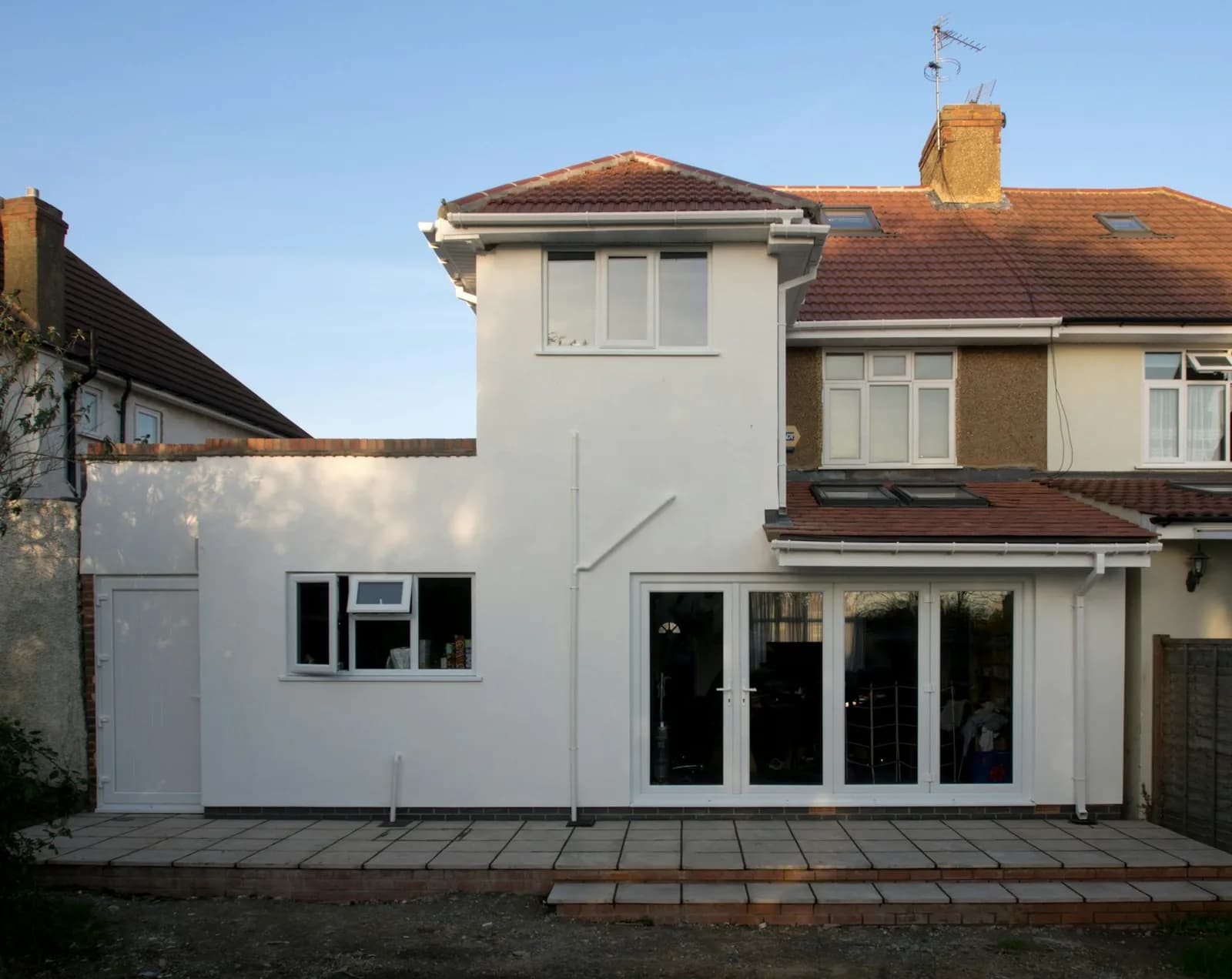
If your house is one of a pair, section 4.3 of the low density chapter treats it that way. The addition has to respect the pair as a coherent whole. The bulk of a first floor sits back from the street and toward the rear, with most of the front roof left intact. On a hipped roof it goes behind the apex. On a gable it's set back from the gable end and keeps the gable details and chimneys. The new roof is either low and visually secondary, or in a style that suits the original.
You can build to the common boundary, but council wants to avoid leaving blank party walls exposed to the street, and any that are left have to be finished properly. If your neighbour already has approval for their own first floor, a later application has to follow its massing, roof pitch and gutter lines. Council encourages the two owners to coordinate and, if possible, lodge together.
The practical side is the shared wall. Before anything is cut, I want an engineer's view on how the roof and floors bear on it, and a title search for easements. It's the one part of the job that affects next door directly, so the neighbour should hear about it early.
Which version of the DCP, and the heritage check
Randwick reviewed its DCP in stages, and Stage 2 commenced on 27 July 2026. Council's transitional note says an application lodged before that date and not yet decided is assessed as if the review hadn't commenced. A design that hasn't been lodged is assessed against the reviewed version, so check the drawings against the current parts before they go in.
The low density chapter also has controls on site coverage, deep soil, landscaping and tree canopy, private open space, setbacks, solar access, privacy and view sharing. A rear ground floor addition is usually tested hardest on site coverage and deep soil, because it builds over the yard.
Heritage sits in Part B2. If the planning certificate shows the house as a heritage item or inside a conservation area, the addition is designed to those controls as well, and the approval path is a DA.
What it costs, and the approval route
For a ground floor addition, Rawlinsons gives $2,620–$2,820/m² for 50–75m² in brick veneer, $2,630–$2,840/m² for 75–125m² in brick veneer and $2,360–$2,550/m² for 75–125m² framed. A full first floor addition is $3,930–$4,230/m² for 75–100m² and $3,790–$4,090/m² for 100–150m². All are Sydney rates excluding GST, escalated to the ABS September 2026 index. A new bathroom in the addition is $37k–$42k and a kitchen $31k–$35k, both including GST.
Rawlinsons doesn't publish a rate for a dormer or attic room, so I price that from the measured roof framing and an engineer's design. Access matters on a tight lot too. Craning materials in or carrying them through the house costs more than a clear side path, and it's priced from the site.
For a complying development certificate, a CDC must be decided within 20 days where neighbours are notified (10 days otherwise). If the extension needs a DA to Randwick City Council, a DA has a 40-day assessment period.
What I check first on a Coogee extension
These set what the addition can look like before we talk about rooms.
- 01
Foreshore Scenic Protection Area and foreshore building line on the certificate
- 02
Heritage item or conservation area status
- 03
The roof framing, if the idea is a dormer or attic room
- 04
Whether the house is half of a semi, and what the neighbour has approved
- 05
Site coverage and deep soil left after a ground floor addition
- 06
When the DA will be lodged, against the reviewed DCP
Coogee extension questions
Is my Coogee house in the Foreshore Scenic Protection Area?
The Randwick LEP 2012 map shows it, and the planning certificate confirms it. If it is, Part B10 of the DCP adds controls on colours, glass, landscaping and retaining walls.
How big can a dormer be?
Under the reviewed Randwick DCP, no more than 1.5m from base to ridge, below the main ridge, at least 500mm in from the sides of the roof, and with its base above the gutter.
Can I add a roof terrace?
On the main roof, up to 12m², if it protects neighbours' privacy, allows view sharing, has no kitchen or barbecue and stays within the height limit. Sloping sites have a few extra options.
My neighbour has already extended their half. Do I have to match?
If their first floor addition is approved, the DCP expects yours to follow its massing, roof pitch and gutter lines. Council encourages owners of a pair to coordinate.
What should be in place before work starts?
First, the contract in writing, which is required for residential building work over $5,000 in value. For work of $20,000 or more including GST, the builder's home building compensation cover, in place before any deposit is paid, which you can check on Service NSW's HBC Check. And a deposit of no more than 10%.
Sources and references
Costs are from the Rawlinsons handbook with the local cost index applied; rules and timeframes are checked against the sources below.
- Randwick City Council
- Rawlinsons Australian Construction Handbook, Rawlhouse Publishing
- Environmental Planning and Assessment Act 1979 (NSW)
- State Environmental Planning Policy (Exempt and Complying Development Codes) 2008
- Home Building Act 1989 (NSW)
- Search heritage databases, NSW Environment and Heritage
- NSW Planning Portal Spatial Viewer (zoning, FSR and hazard maps)
- Australia Post postcode search
Start with the certificate and the roof
Tell me the address and what you'd like to add. Oliver will respond within 4 working hours for a free initial conversation, and the price comes once the house and roof have been measured.